


What if your marketing doesn’t need a new channel, but a fix at one weak point in the customer journey? When leads or sales stay inconsistent despite steady effort, it can be hard to know what to do when your marketing isn’t working. The answer isn’t always to spend more or start over. First, find where potential customers are dropping off.
You may already suspect something is underperforming, but the cause isn’t always obvious. Low-quality leads could point to a targeting or messaging issue, while strong traffic with few inquiries may signal a website problem. Changing tactics before checking the evidence can add work without fixing the real breakdown.
This 2026 action plan shows how to use performance data to identify the main issue, choose a response that fits your business goals, and prioritize changes based on likely impact and your team’s capacity. You’ll learn how to assess channels, messaging, and website performance, when to adjust your approach, and when expert support may help. The goal is a clear path from uncertainty to practical next steps.
Key Takeaways
- Separate attention metrics from outcomes like qualified inquiries and sales to see whether marketing is reaching the right people.
- To work out what to do when your marketing isn’t working, follow the customer journey and check that tracking captures actions tied to your goal.
- Match symptoms to likely causes: unclear offers may point to messaging, while traffic that doesn’t convert may call for a closer look at your website.
- Build a focused recovery plan around one business outcome and audience, then rank possible fixes by evidence, customer impact, effort, and capacity.
- Consider outside support when diagnosis or coordinated execution stretches your team. Ask how a partner sets priorities and reports progress.
Marketing Not Working: Recognize the Real Symptoms
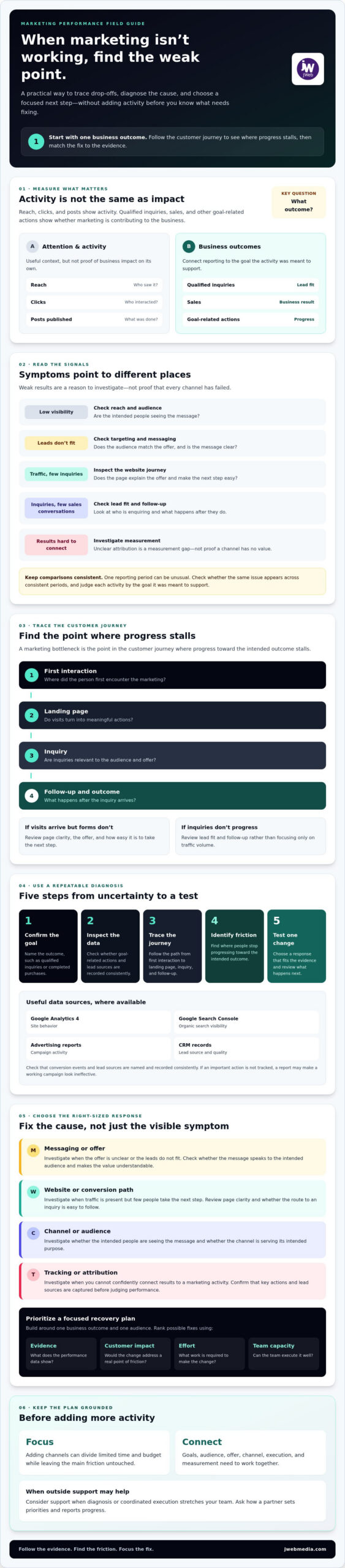
Weak results are a reason to investigate, not proof that every marketing channel has failed. If you’re asking what to do when your marketing isn’t working, start by separating activity from impact. Reach, clicks, and posts published show what your team is doing. Qualified inquiries, sales, and other goal-related actions show whether that activity is contributing to the business.
Look for patterns: leads that don’t fit your offer, visitors who leave without taking a next step, inquiries that arrive inconsistently, or results you can’t confidently connect to a marketing activity. Each pattern points to a different place to investigate. Low visibility, for example, is not the same problem as strong traffic that produces few qualified inquiries.
For another perspective on diagnosing marketing performance, watch this video:
Which marketing warning signs deserve attention?
One reporting period can be unusual. Before making a major change, compare performance across consistent periods and check whether the same issue keeps appearing. Then assess each activity against the goal it was meant to support. A campaign designed to generate inquiries should be judged by inquiry quality and volume, not reach alone.
- Visibility: Are the intended people seeing the message?
- Engagement: Do they interact or explore further?
- Lead quality: Do inquiries fit the audience and offer?
- Conversion: Do interested people take the next step?
If your reporting can’t show where a contact came from or what happened after they arrived, attribution may be unclear. Treat that as a measurement gap to investigate, not proof that a channel has no value.
Why more marketing activity may not solve the problem
Adding channels can divide limited time and budget while leaving the main friction untouched. More posts won’t necessarily clarify an offer, and more website traffic won’t automatically lead to useful inquiries. Results depend on goals, audience, offer, channel, execution, and measurement working together. A gap in any one area can weaken the whole effort.
Useful marketing measurement connects activity to a defined business outcome. A clear marketing plan links what the business wants to achieve with the audience, activities, and measures used to assess progress. Check whether each activity has a specific purpose and whether your reporting shows what happened next.
How to diagnose why your marketing is underperforming
A useful diagnosis follows the customer’s path rather than treating every channel as a separate mystery. Start by naming the business outcome you want, such as qualified inquiries or completed purchases. Then check whether your measurement setup records the actions that signal progress toward it. If an important form submission isn’t tracked, a report may make a working campaign look ineffective.
Check goals, tracking, and the customer journey
Use a repeatable sequence: confirm the goal, inspect the data, trace the journey, identify friction, and test one change. Review Google Analytics 4 for site behavior, Google Search Console for organic search visibility, advertising reports for campaign activity, and CRM records for lead source and quality, where available. Check that conversion events and lead sources are named and recorded consistently.
Follow a typical visit from its first interaction to the landing page, inquiry, and follow-up. Compare landing-page visits with meaningful actions, not traffic volume alone. If visits arrive but few people submit a form, check whether the page explains the offer clearly and makes the next step easy. If inquiries arrive but rarely become sales conversations, look at lead fit and follow-up. A marketing bottleneck is the point in the customer journey where progress toward the intended outcome stalls.
Choosing the right measures is part of learning how to measure marketing effectiveness. For organic planning, a focused SEO content strategy guide can help connect search visibility with the audience and goals your content is meant to serve.
Find the gap between audience, message, and offer
Check whether the message speaks plainly to a specific audience need. Compare the promise in an ad, search result, or social post with the landing page and the offer itself. If an ad highlights one benefit but the page leads with something else, visitors may lose confidence or leave before acting. Consistent language helps people recognize that they’ve reached the right place.
Then review inquiry quality and what happens after someone responds. Are the inquiries from people you can serve? Does the follow-up answer their questions and make the next step clear? These checks help distinguish a targeting or message mismatch from friction on the website or in the sales handoff.
Once you’ve identified the likeliest gap, change one element and monitor the same goal and journey. For example, clarify the landing-page offer while keeping the audience and campaign steady. If you’d like a partner to help assess paid campaign performance, explore jWeb Media’s marketing support as one possible next step.
Which marketing fix should you choose: messaging, website, or channel?
Once you’ve identified where progress slows, match the response to the evidence. The right answer to what to do when your marketing isn’t working may be a clearer offer, a more useful landing page, or a different way to reach your audience. Use the symptom as a starting point, then test one likely cause rather than changing everything at once.
| Observed symptom | Investigate | First test |
|---|---|---|
| People don’t understand the offer, or inquiries are a poor fit. | Messaging, audience language, and offer relevance. | Test a clearer headline or value proposition with the same audience. |
| Relevant visitors arrive but don’t take action. | Page relevance, mobile usability, calls to action, and inquiry flow. | Make the next step clearer on one landing page. |
| The intended audience isn’t seeing the campaign. | Channel fit, targeting, and campaign delivery. | Review audience and channel settings before shifting spend. |
When should you revisit your message or offer?
Prioritize messaging when people seem unsure what you offer, why it matters to them, or whether it fits their needs. Watch for broad claims that could apply to any business, language that doesn’t reflect how customers describe their problem, or inquiries from prospects you can’t serve well. Try one specific, plain-language version against the current message while keeping other variables steady. Messaging won’t fix broken tracking, poor delivery, or slow sales follow-up.
When should you improve the website or change channels?
If people show interest but don’t act, inspect the destination before sending more traffic. Confirm the page matches the ad or content promise, works well on mobile, makes the call to action easy to find, and keeps the inquiry process straightforward. If the right people aren’t being reached, assess channel fit against audience behavior, campaign objective, and your team’s capacity to manage it.
For paid campaigns, review targeting, delivery, and the path from ad to landing page before deciding whether to adjust the channel or the experience. Professional PPC management may be worth exploring if campaign optimization is the relevant next step. Set a clear measure before testing and change one element at a time. The result will give you useful evidence for your next decision.
How to build a focused marketing recovery plan
A useful recovery plan turns diagnosis into a manageable test. Choose one primary business outcome, such as more qualified inquiries, and one clearly defined audience for the first improvement cycle. This grounds the work in a business goal instead of a broad wish to “get better results.” It also helps your team focus on the customer experience most closely connected to that outcome.
Next, rank possible fixes by the strength of the evidence, likely customer impact, effort required, and your capacity to implement the change. A high-impact website update may not be the right first move if your team can’t support it yet. Start with a change you can carry through and measure reliably.
Prioritize one test instead of changing everything
Before beginning, write down the issue, evidence, proposed change, person responsible, and success measure. For example, if visitors reach a service page but rarely submit an inquiry, test a clearer call to action while leaving traffic sources and other page elements unchanged. Keep the test proportionate to the traffic available, your resources, and the risk of making a larger change.
Focused tests make results easier to interpret because you can connect a change to the evidence that follows.
Review results and decide what happens next
Set a review point that fits the campaign cycle and the amount of data you can reasonably collect. A short, low-volume campaign may need more time to produce a useful signal than a high-traffic page. Don’t treat any universal timeline as a rule. At review, compare results with your original goal and baseline, using the same definitions and tracking method.
Record what changed and what the evidence supports, or doesn’t support. If the measure moves in the intended direction and the data is meaningful, consider continuing or building on the test. If results are mixed, adjust one element and review again. If the change doesn’t address the issue, stop and revisit your diagnosis. Don’t let frustration or one unusual data point make the decision for you.
For ongoing planning, the monthly marketing retainer guide offers another perspective on sustained optimization. If coordinating a recovery plan or carrying out marketing changes is beyond your team’s capacity, explore marketing support from jWeb Media as a collaborative option.
When to Hire a Marketing Partner and What to Expect
Outside support may help when diagnosing a performance issue, carrying out the work, or coordinating activity across channels stretches your team’s capacity. You don’t need to hand over everything. A partner can focus on the specific gap you’ve identified, while your team contributes its knowledge of customers, offers, and business priorities.
Before engaging anyone, be clear about the problem you want to solve. If you’re still weighing what to do when your marketing isn’t working, a prospective partner should help you understand the evidence and possible next steps, not rush to add more activity. The right fit depends on your goals, internal resources, and the work required.
What should a useful marketing partnership include?
Ask how discovery works and what information the partner will review before making recommendations. Look for clear objectives, defined responsibilities, transparent reporting, and regular conversations about priorities. You should know who handles each task, how progress will be measured, and how recommendations connect to the issue you’ve identified.
Useful questions include: How will you assess our current performance? What would you need from our team? How do you decide which work comes first? What will reporting show? Answers should connect proposed services to your business goals and the customer journey. If the diagnosed issue is a mismatch between an ad and its landing page, unrelated activity may not address it.
Choose support that fits the problem you found
Match expertise to the bottleneck. If visitors struggle to act on your website, custom website design or development may be relevant. If the challenge is organic visibility, SEO or content marketing could fit. If your audience isn’t responding to paid campaigns, PPC management may be worth discussing. Social media management may suit a need for more consistent activity on social channels. Each option should follow from the evidence, not a generic package of tasks.
jWeb Media works across website design, SEO, PPC, content, and social media. These services may help address different parts of the customer journey, but they aren’t an automatic fix. A productive conversation should start with your goals, what you’ve already tried, and what your current data shows. Together, you can consider whether outside support fits and identify a practical next step.
Talk with jWeb Media about your business goals and current marketing challenges. You don’t need to arrive with a complete solution; a clear picture of what’s happening is a helpful place to begin.
Take the Next Step With a Clearer Marketing Plan
Underperforming marketing doesn’t mean every channel needs replacing. It’s a signal to find where customer progress slows, check that your data reflects a meaningful business goal, and choose a focused change based on what you learn. Keep the first improvement cycle manageable: work toward one outcome with one audience, then review the evidence before deciding what to do next.
If you’re still weighing what to do when your marketing isn’t working, outside perspective may help when diagnosis or execution is beyond your team’s capacity. Founded in 2004, jWeb Media provides custom website design, SEO, PPC management, and social media management. The right support depends on the challenge you’ve identified, and any partnership should start with your goals and current marketing activity.
Talk with jWeb Media about your marketing goals and discuss a practical next step for your business. You don’t need to have every answer before starting the conversation. A clearer path can begin with one well-informed decision.
Frequently Asked Questions
What should I do first when my marketing isn’t working?
Start by defining the business outcome you expected and checking whether your tracking records it. If you’re asking what to do when your marketing isn’t working, trace the customer journey from first contact to inquiry or sale. Look for where progress slows, then compare that point with the audience, message, offer, and channel involved. Choose one evidence-based change to test instead of replacing several parts of your marketing at once.
How do I know whether my marketing strategy or execution is the problem?
Check whether the plan is aimed at the right audience and outcome, then confirm the work is being carried out and measured as intended. A strategy issue may show up as an unclear goal, a poor audience fit, or an offer that doesn’t meet customer needs. Execution issues can include inconsistent delivery, incorrect campaign settings, or missing conversion tracking. Review each stage before deciding which needs attention.
Should I stop marketing if it isn’t generating leads?
Not necessarily. First check whether the activity was meant to generate leads directly or support another step, such as awareness or consideration. Confirm that lead tracking works, the intended audience is being reached, and the page or offer gives people a clear next step. If evidence points to wasted effort, you might pause or reduce that specific activity while investigating, rather than stopping all marketing without a plan.
How long should I wait before changing a marketing campaign?
Wait until the campaign has run long enough to produce data relevant to its goal, but don’t rely on a fixed timeline for every campaign. The right review point depends on the campaign cycle, audience response, available traffic, and how many meaningful actions you can observe. Check tracking early, then compare results with the original baseline using consistent measures. Avoid making a major decision based only on one unusual result.
Can a new website fix marketing that isn’t working?
A new website may help if the current site makes it difficult for interested visitors to understand the offer or take action. Before committing to a redesign, check page relevance, mobile usability, calls to action, and the inquiry process. A website change won’t by itself resolve issues such as poor audience targeting, unclear campaign messaging, or weak follow-up. Identify where customers are getting stuck so the website work addresses a diagnosed need.
When should I hire a digital marketing agency?
Consider an agency when diagnosing the issue, implementing changes, or coordinating marketing exceeds your team’s capacity. Ask how the agency will review current performance, define responsibilities, report progress, and choose priorities before recommending work. jWeb Media provides custom website design, SEO, PPC management, and social media management. The right support depends on your specific needs, and a useful partnership should connect its work to your business goals.