


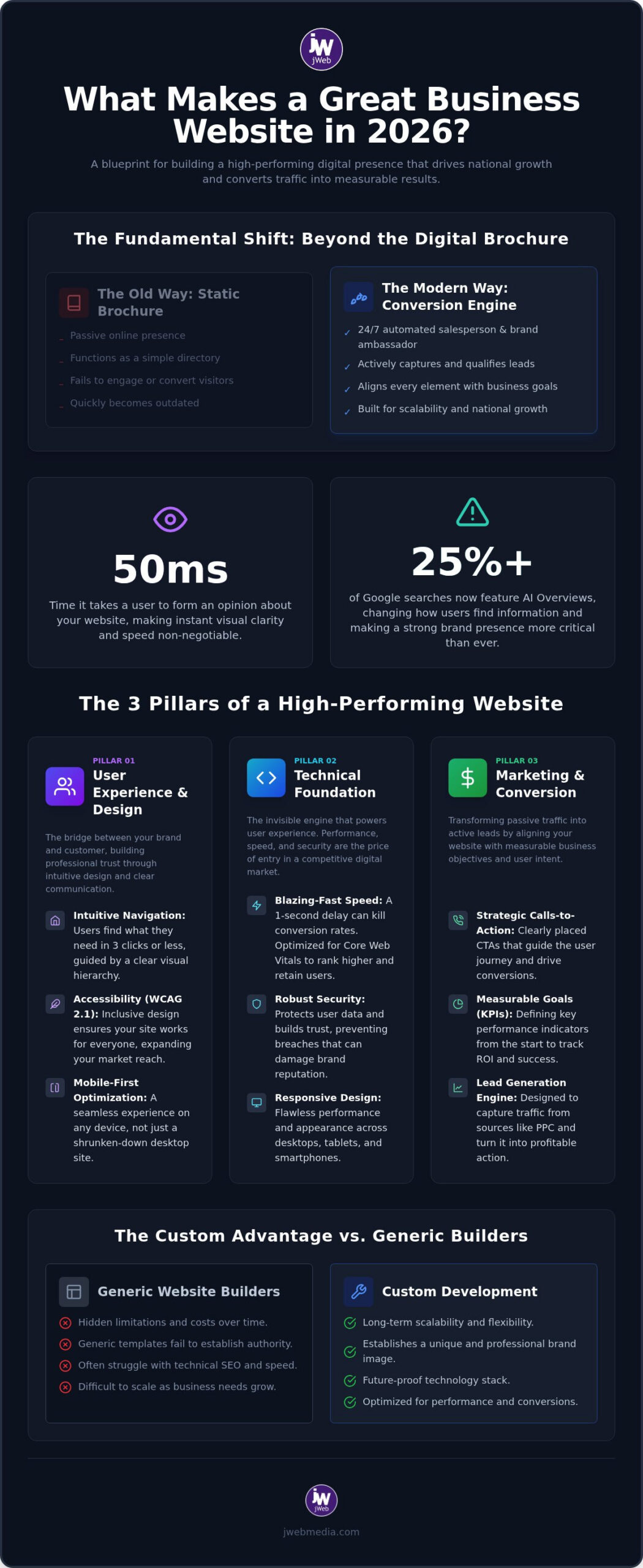
What if the top spot on Google no longer guaranteed your business a steady stream of traffic? With AI Overviews now appearing in more than 25% of searches, the digital landscape has shifted, and simply having a site isn’t enough anymore. It’s common to feel overwhelmed by the constant flux of technical requirements like Core Web Vitals or the challenge of standing out in a saturated national market. You want a site that works as hard as you do, but poor conversion rates often tell a different story. Understanding what makes a good business website in 2026 requires looking past aesthetics to see your site as a strategic, lead-generating engine.
We’re here to help you bridge the gap between complex technical demands and your practical business goals. In this guide, you’ll discover the essential elements that transform a basic site into a high-converting platform built for national growth. We’ll provide a clear blueprint for building a professional brand image that earns trust instantly while ensuring your technology is future-proof. From automated lead generation to meeting the latest accessibility standards, we’re exploring how to create a digital presence that delivers consistent, measurable results.
Key Takeaways
- Learn why shifting from a static digital brochure to a dynamic conversion engine is the first step in modernizing your online presence.
- Understand how intuitive navigation and design psychology work together to build immediate professional trust with your audience.
- Discover how technical performance and site speed serve as the foundation for what makes a good business website in a competitive national market.
- Identify the strategic placement of calls to action that guide user behavior and turn passive traffic into consistent leads.
- Explore the long-term scalability of custom development compared to the hidden limitations and costs of generic website builders.
Defining the Purpose: What Makes a Good Business Website Today?
Your website isn’t just a place where your logo lives. In 2026, it serves as your most dedicated employee, working as a 24/7 salesperson and brand ambassador. The old idea of a “digital brochure” is dead. Today, understanding what makes a good business website means viewing it as a conversion engine designed to drive national growth. It’s the difference between a static page that sits there and a strategic tool that actively captures leads while you sleep. Every element must align with your broader business objectives, whether that’s building brand authority or scaling sales across the country.
First impressions happen faster than a blink. Research shows that users form an opinion about your brand in about 50 milliseconds. If your site doesn’t load instantly or fails to communicate value immediately, visitors bounce. Visual clarity and technical performance aren’t just “nice to have” anymore; they’re the entry price for digital competition. A site that lags even by a second can kill your conversion rates before a potential client even reads your headline.
To better understand this concept, watch this helpful video:
The Core Pillars of Digital Authority
Trust starts with how you present yourself to the world. Generic templates often feel hollow and fail to scale, whereas professional custom design establishes immediate authority. Consistency is key here. Your site needs to feel like a natural extension of your brand across every digital touchpoint. This includes implementing Responsive web design to ensure a seamless experience on any device, from a smartphone to a desktop. A high-performing website is a delicate balance of intuitive user experience and robust search engine optimization.
Setting Measurable Goals for Your Site
Building a site without clear goals is like driving without a map. You need to identify Key Performance Indicators (KPIs) before writing the first line of code. Are you looking for direct sales, or is lead generation your primary driver? User intent should dictate every part of your navigation and site structure. We often use a “Voice of Customer” approach to ensure the design speaks directly to what your audience actually needs. This strategic alignment ensures that every visitor has a clear, frictionless path toward a conversion. If you’re investing in PPC management, your landing pages must be ready to catch that traffic and turn it into measurable profit immediately.
User Experience (UX) and Design: The Human Element
Design is the bridge between your brand and your customer. When people ask what makes a good business website, they often think of colors and logos. While those are vital, true UX design focuses on how a visitor feels while moving through your pages. Professional trust is built through a thoughtful use of white space, which allows content to breathe, and typography that ensures readability. Color psychology also plays a role. It can subtly nudge a visitor toward a specific action or evoke a sense of security. For instance, deep blues often convey reliability, while high-contrast buttons can drive urgency and focus.
In 2026, accessibility is a fundamental standard. Following WCAG 2.1 AA standards ensures your site works for everyone, including those using screen readers or other assistive technologies. This isn’t just about legal compliance; it’s about inclusivity and reaching your entire potential market. Similarly, your site must be mobile-optimized. It’s no longer enough to just fit on a smaller screen. Navigation menus need to be intuitive for touch, and layouts must adapt to the way people actually hold their devices. A seamless mobile experience is a prerequisite for any business aiming for national visibility.
Creating a Seamless User Journey
The “Three-Click Rule” remains a gold standard for national brands. If a user can’t find what they need in three clicks, they’ll likely leave. We use visual hierarchy to guide the eye toward your primary conversion goals, ensuring that the most important information stands out. Bold headings, strategic spacing, and contrasting colors act as signposts for your visitors. Understanding the Importance of UX in Website Redesign is essential for any business looking to fix poor conversion rates. By mapping out a frictionless path, you turn a confusing site into a streamlined sales tool that respects your customer’s time.
Visual Storytelling and Brand Identity
Authenticity is the currency of 2026. Custom imagery almost always outperforms generic stock photos because it shows the real people and processes behind your brand. This level of custom website design reflects your unique value proposition in a way a template never could. You can integrate video and interactive elements to tell your story, but you must do so without sacrificing performance. High-quality visuals should support your message, not distract from it. When these pieces come together, your website becomes a living part of your brand identity rather than just a digital placeholder, fostering a deeper connection with your audience.
Technical Foundation: Performance, Speed, and Security
While a beautiful design captures attention, the technical foundation determines whether a visitor stays or leaves. A slow site isn’t just a minor inconvenience. It’s a conversion killer. Search engines prioritize performance because they want to provide the best possible experience for their users. If your pages lag, your rankings and your revenue will suffer. Speed is the first layer of user experience. When we look at what makes a good business website in 2026, we have to start with the “under the hood” mechanics that keep everything running smoothly.
Technical SEO acts as the roadmap for search engine crawlers. Clean code architecture, XML sitemaps, and Schema markup help search engines understand exactly what your business offers. This is especially important as AI-driven search becomes more prevalent. Structured data allows your content to be indexed accurately, increasing your chances of appearing in featured snippets or AI overviews. Without this invisible infrastructure, even the best content can go unnoticed by your target audience.
Optimizing for Core Web Vitals
In the 2026 search landscape, Core Web Vitals are the primary metrics for measuring site health. You need to focus on Largest Contentful Paint (LCP), First Input Delay (FID), and Cumulative Layout Shift (CLS). These track how fast your main content loads, how quickly the site responds to user interaction, and whether the layout remains stable. Clean development is the best way to avoid “code bloat,” which often happens with generic templates. By building with a lean, custom approach, you ensure your mobile performance is snappy and reliable for a national audience.
Scalable Hosting and Infrastructure
Cheap hosting is often a hidden tax on your growth. It might save money upfront, but it costs much more in lost leads and downtime during traffic spikes. A robust technical foundation requires secure hosting and a reliable Content Management System (CMS) like WordPress or Shopify. These platforms allow for easy security updates and data protection measures, such as SSL certificates. Security is a cornerstone of professional trust. If a browser flags your site as “not secure,” you’ve lost that customer before they’ve even seen your homepage.
Maintaining a custom site involves more than just a one-time setup. Regular updates and performance monitoring are essential to keep your technology future-proof. If you’re looking for a partner to help navigate these technical choices, our Guide to Choosing a Custom Website Design Company offers a deeper look at what to expect. A steady, expert hand ensures your site remains a high-performing asset that grows alongside your business goals.
Marketing Integration: Turning Traffic into Conversions
A website without marketing integration is like a billboard in the middle of a desert. It might be beautiful, but if nobody sees it, it won’t drive results. When we evaluate what makes a good business website, we have to look at how it turns strangers into customers. This process starts with Search Engine Optimization (SEO) from the very first wireframe. If you wait until after launch to think about search authority, you’re already behind. You need a structure that search engines can crawl easily and content that answers the specific questions your national audience is asking.
Strategic placement of Calls to Action (CTAs) is another critical piece of the puzzle. You shouldn’t just bury a “Contact Us” button in the footer and hope for the best. Instead, use high-contrast buttons and persuasive copy that guides visitors through their journey. Every page should have a clear purpose. Whether it’s signing up for a newsletter or requesting a custom quote, the path must be obvious and frictionless. We focus on creating these touchpoints so your site acts as a 24/7 lead generator.
Aligning Design with Paid and Organic Strategy
Paid advertising and organic search shouldn’t live in silos. Your landing pages play a massive role in your Quality Score and overall ad spend ROI. If a user clicks a targeted ad but lands on a generic homepage, they’ll likely bounce. Instead, we design specific pages that mirror the intent of your Professional PPC Management services. This ensures a cohesive experience that keeps visitors engaged. We call this “sticky” content. It’s designed to provide so much value that users stay on your site longer, which signals to search engines that your brand is a trusted authority.
The Role of Social Proof and Lead Capture
Trust is earned, not given. Integrating testimonials, case studies, and reviews naturally throughout your site builds immediate credibility. When a potential client sees that you’ve solved similar problems for others, their hesitation fades. You can also use effective lead magnets to capture contact information. This might be a white paper, a checklist, or an exclusive webinar. By offering genuine value in exchange for an email address, you build a list of warm leads that you can nurture over time. For a deeper look at how these elements work together in a broader campaign, check out our Professional PPC Management Guide. If you’re ready to build a site that actually grows your business, let’s talk about a custom strategy that fits your specific goals.
The Custom Advantage: Why a Strategic Partner Matters
Choosing between a generic template and a custom build is often the most critical decision a business owner makes. While DIY builders promise low upfront costs, they frequently come with hidden “technical debt” that limits your ability to scale. When considering what makes a good business website, you have to look at the long-term flexibility of your platform. Templates often force you to compromise on your brand’s unique needs. This leads to a site that looks just like your competitors’ and fails to capture your specific voice. A custom solution provides a unique competitive edge in a saturated market by reflecting your exact value proposition without the bloat of unnecessary features.
Scalability is the cornerstone of national business growth. A site that works for a handful of visitors might crumble when your marketing campaigns start driving thousands of leads. Custom development allows your infrastructure to grow alongside your ambitions. You won’t be held back by the rigid structures of a “one-size-fits-all” builder. Instead, you have a platform that can be adjusted, expanded, and optimized as your business model evolves. This level of control is what separates a simple digital placeholder from a strategic business asset.
Investing in Long-Term ROI
A custom website should be viewed as a capital asset rather than a simple business expense. Because it’s built specifically for your goals, it offers a much higher return on investment over time. You aren’t just paying for code; you’re investing in a foundation that supports national growth. Having a dedicated team to handle SEO and marketing updates ensures that your site remains relevant as search algorithms evolve. Understanding the Value of Monthly Marketing Retainers allows you to maintain this momentum without having to hire an entire in-house department. This ongoing support keeps your technical foundation secure while your marketing strategy stays sharp and effective.
Choosing the Right Agency Partner
Finding the right full-service digital agency is about more than just checking a list of technical skills. You need a partner that values transparency and communication as much as you do. Shared goals are the backbone of any successful collaboration. A reliable agency acts as a supportive guide, helping you navigate the complexities of the digital space with confidence. They should be deeply invested in your growth and visibility, treating your success as their own. This partnership-oriented approach bridges the gap between complex technical services and your practical business needs. It’s helpful to remember that a website is never finished; it is a living part of your business strategy.
Building Your Future-Proof Digital Engine
The digital landscape in 2026 demands more than just a placeholder. It requires a strategic ecosystem where design, technical speed, and marketing integration work in perfect harmony. By prioritizing user experience and a robust technical foundation, you ensure that your site doesn’t just attract visitors but converts them into loyal customers. Understanding what makes a good business website means recognizing that your online presence is a living part of your business strategy, requiring constant care and expert guidance.
As a full-service agency founded in 2004, jWeb Media provides the expert team and custom design capabilities needed to drive national growth. We don’t just build sites; we build partnerships that turn complex technical challenges into measurable success. Ready to build a website that actually works? Contact jWeb Media today for a custom consultation. Your business deserves a platform that scales with your ambitions and reflects your unique value. Let’s start building your strategic blueprint together.
Frequently Asked Questions
What are the most important features of a business website in 2026?
High performance and accessibility are the top priorities. In 2026, your site must meet WCAG 2.1 AA standards to ensure inclusivity and legal compliance. Beyond that, fast load times and intuitive user paths define what makes a good business website. You also need a strategic layout that aligns with your specific conversion goals. These elements work together to build trust and drive lead generation across a national market.
How much does a custom business website cost to develop?
The investment for a custom site depends on your specific business goals and the complexity of the project. While DIY builders might seem cheaper upfront, they often lead to technical debt and limited scalability. A professional agency build involves a comprehensive discovery phase, custom UI/UX design, and specialized coding. This approach ensures your site is a capital asset that provides long-term value rather than a recurring technical headache.
Is a custom website better than a template for SEO?
Custom sites offer a significant advantage for SEO because they avoid the code bloat found in many generic templates. Clean code architecture and lean development help your site meet Core Web Vitals standards more easily. This technical precision improves site speed and crawlability, which are vital ranking signals. Starting with a custom foundation allows you to integrate SEO strategy into what makes a good business website from day one.
How often should a business website be updated or redesigned?
You should update your content regularly through blogs or resource pages to maintain search authority. However, a full technical redesign is typically recommended every two to three years. This cycle ensures your site keeps pace with changing user behaviors, security standards, and search engine algorithms. Regular maintenance through a monthly retainer can extend the life of your site by keeping the underlying technology secure and performance optimized for national competition.
What is the difference between web design and web development?
Web design focuses on the visual identity and user journey of your site. It involves choosing color palettes, typography, and layouts that build professional trust. Web development is the technical side that brings those designs to life through coding. Developers ensure the site is fast, secure, and functional across different browsers. A successful business site requires a partnership between these two disciplines to balance aesthetics with high-level performance.
Why is mobile responsiveness so important for national brands?
Mobile responsiveness is critical because the majority of national search traffic now happens on smartphones. Google uses mobile-first indexing, meaning your mobile site is the primary version used for rankings. If your site is difficult to navigate on a phone, you’ll lose potential customers and see your search visibility drop. A mobile-optimized site ensures a seamless experience for every visitor, regardless of the device they use to find you.
Can I manage a custom-designed website myself after it launches?
Most custom websites are built on user-friendly Content Management Systems like WordPress or Shopify. This allows you to manage blog posts, update images, and edit text without needing to write any code. While you can handle daily content updates yourself, it’s often beneficial to have a strategic partner for technical maintenance and security updates. This ensures your site remains a high-performing asset while you focus on running your business operations.
How does a good website help with my PPC and social media marketing?
Your website is the ultimate destination for every marketing campaign. For PPC, a high-quality landing page can improve your Quality Score and lower your cost per click. For social media, a professional site provides the credibility needed to turn followers into leads. Integrating these channels ensures that your marketing spend isn’t wasted on a site that fails to convert. A well-designed site acts as the hub for your entire digital strategy.