


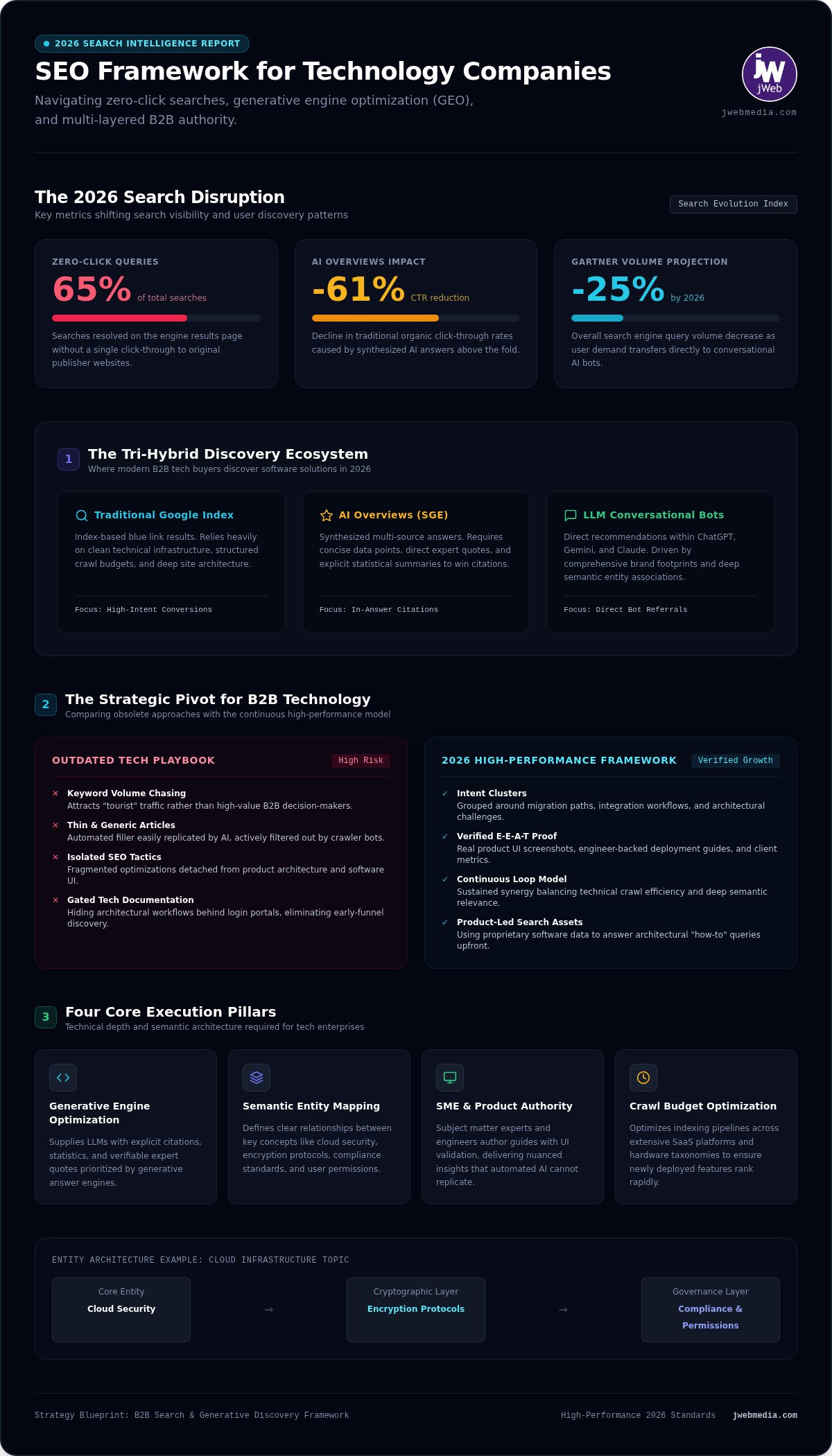
With zero-click search rates now reaching 65% and AI Overviews reducing traditional click-through rates by as much as 61%, the old playbook for SEO strategies for technology companies is officially broken. You’ve likely noticed that even your most authoritative technical content is being summarized by bots before a user ever reaches your site. It’s a challenging time to manage growth when the rules of visibility seem to change every week.
We understand that your goal isn’t just to rank; it’s to build a reliable pipeline of organic leads in an increasingly crowded market. This guide provides a clear framework to master the high-performance tactics that dominate the 2026 search environment. You’ll learn how to align your product’s technical authority with the way modern buyers and generative engines actually find solutions. We’ll cover everything from Generative Engine Optimization (GEO) to product-led scaling, giving you a steady hand to navigate the future of search with confidence.
Key Takeaways
- Learn how to move beyond traditional rankings to secure vital citations within AI Overviews and generative search engines.
- Discover multi-layered SEO strategies for technology companies that balance technical site architecture with the deep semantic content required for high B2B authority.
- Understand the shift toward product-led SEO and how to use your software’s unique data to create high-converting search assets.
- Identify the specific content modifications that increase your visibility in Large Language Models by providing the statistics and expert quotes they prioritize.
- See why an integrated approach to custom website design is the essential foundation for meeting modern performance standards and driving organic leads.
The 2026 Tech SEO Landscape: Why Traditional Tactics Are Not Enough
The search ecosystem in 2026 is no longer a simple directory of websites. It is a hybrid environment where traditional index-based results live alongside synthesized AI answers. We’re no longer just optimizing for a list of blue links. We’re optimizing for a generative engine optimization framework where Large Language Models (LLMs) like Gemini and ChatGPT retrieve, summarize, and recommend your brand based on your digital footprint. High-performance SEO strategies for technology companies must now account for Google Search, AI Overviews, and direct referral traffic from conversational bots. Tech SEO is the alignment of product authority with AI-driven discovery.
To better understand how this framework drives growth in the current market, watch this helpful video on scaling SaaS search traffic:
Tech companies face much higher E-E-A-T requirements than other sectors. Your products often represent significant financial or infrastructure investments for your clients, making “Trust” the most critical metric. In a world where generative AI can churn out generic articles in seconds, “thin” content has become a major liability. If your content lacks unique data, expert insights, or specific statistics, it won’t just rank poorly. It will be filtered out by the crawlers that feed AI summaries, leaving your brand invisible during the buyer’s initial research phase.
The Shift from Keyword Volume to Intent Clusters
Chasing high-volume keywords often leads to “tourist” traffic rather than qualified B2B leads. In 2026, successful SEO strategies for technology companies focus on intent clusters. For SaaS and hardware firms, this means grouping content around specific migration paths, integration workflows, or architectural challenges. Your technical documentation shouldn’t just be for existing users; it’s a powerful tool for capturing top-of-funnel searchers. When you answer a specific “how-to” architectural question, you position your product as the natural solution before the buyer even reaches a pricing page.
E-E-A-T for Tech: Proving Experience and Expertise
Experience is the standout factor in the current search landscape. Google prioritizes content that demonstrates real-world product usage. This includes verified screenshots of your UI, detailed case studies with performance data, and commentary from your own engineers. AI can’t replicate the nuance of a Subject Matter Expert (SME) explaining a complex deployment. By involving your product team in content creation, you bypass AI filters and build genuine authority. You can see how this integrates into a broader SEO content strategy to ensure your brand remains a steady hand in a fast-moving industry.
Core SEO Strategies for Technology Companies: A Multi-Layered Approach
Effective SEO strategies for technology companies require a shift from isolated tactics to a cohesive, multi-layered framework. We view this as a “Continuous Loop” model. Since search is always evolving, your strategy must be a sustained partnership between technical performance and content relevance. This is especially urgent given the Gartner projection on search volume decline of 25% by 2026. As AI chatbots handle more queries, your site must provide the deep, structured data they rely on to recommend your services.
On-page optimization has also moved beyond simple keyword placement. Modern semantic structures require you to organize information around entities and relationships. Instead of just targeting “cloud security,” your content must define the relationships between encryption, compliance, and user permissions. This depth ensures that search engines see your site as a comprehensive resource rather than a collection of disconnected pages. By building these semantic maps, you make it easier for both users and AI agents to navigate your expertise.
Technical Infrastructure for Complex Tech Sites
Technical SEO is the foundation. For large-scale SaaS platforms or hardware catalogs, managing your crawl budget is essential. If search bots get lost in complex taxonomies, your newest features won’t get indexed. We focus on clean site architecture and fast visual rendering. High site speed and solid Core Web Vitals aren’t just about rankings; they build buyer trust. Implementing specific Schema.org markup, like SoftwareApplication and Product types, helps search engines understand exactly what you sell and how it functions.
Building a High-Authority Backlink Profile in Tech
Traditional link building often fails in the tech sector because generic directories don’t carry weight. High-performance off-page SEO strategies for technology companies prioritize “Tier 1” industry citations instead. This means building authority through technical PR and active participation in developer communities. Contributing to open-source projects or establishing technical partnerships can earn high-quality links that bots and humans both respect. Strategic guest posting on respected tech hubs ensures your brand is seen where your buyers spend their time.
A successful strategy links these technical details back to your business goals. It’s about being visible where it matters most to your future partners. If you’re looking for a dedicated team to help manage these complexities, our full-service marketing team is ready to act as your steady hand in this fast-moving industry.
Product-Led SEO vs. Content-Driven SEO for SaaS
Navigating SEO strategies for technology companies often comes down to a choice between two powerful growth engines: product-led and content-driven. Product-led SEO leverages your software’s internal data, features, or integrations to generate high-value search pages automatically. Think of a project management tool that offers hundreds of public workflow templates. Conversely, content-driven SEO builds authority by educating your audience and solving their technical hurdles through long-form guides and research. While they serve different purposes, the most successful tech brands integrate both to ensure maximum coverage across the buyer’s journey.
Your choice between these paths often depends on your company’s current maturity and funding. Early-stage startups frequently lean on content-driven tactics to establish a brand voice and build trust from scratch. More mature SaaS companies with established datasets can pivot toward product-led models to achieve massive scale without a linear increase in content production costs. Balancing these approaches requires a deep understanding of Digital.gov search optimization principles, particularly concerning how structured content architecture impacts crawlability and user experience.
Scaling with Product-Led Pages
Scaling doesn’t always mean writing more blog posts. You can turn your software’s core functionality into a search magnet by creating programmatic pages for integrations, templates, or interactive calculators. Programmatic SEO allows you to dominate long-tail queries by generating pages that solve specific user problems at scale. However, automation requires a steady hand. You must maintain strict quality control to ensure these pages provide genuine value rather than becoming “thin” content. According to 2026 benchmarks from OneLittleWeb, product-led assets like interactive calculators convert at 2x to 4x the rate of static educational articles, making them essential for a predictable pipeline.
The Role of Thought Leadership in Content-Led SEO
Content-led SEO is where you define your category. By creating “pioneer content,” you aren’t just chasing existing keywords; you’re setting the narrative for how a technical problem should be solved. We use Voice of Customer reports to identify the exact technical questions your prospects are asking but can’t find answers to. This insight allows you to build guides that resonate on a human level while satisfying search algorithms. If you’re struggling to balance these two pillars, choosing the right partner from the top search engine optimization companies can help you align your technical execution with your long-term business goals.
Navigating the AI Search Shift: GEO and AEO Strategies for Tech
While traditional search engines still drive the majority of B2B traffic, the discovery process for tech buyers has fundamentally shifted. Generative Engine Optimization (GEO) is now a core requirement for high-performance SEO strategies for technology companies. Unlike traditional SEO, which focuses on ranking for specific keywords, GEO is about ensuring your brand, technical specs, and whitepapers are synthesized and cited by Large Language Models (LLMs) like ChatGPT, Claude, and Perplexity. Research from the 2024 Princeton GEO-bench study shows that adding specific statistics to your content can lift AI engine visibility by 37% to 41%. This isn’t just about being found; it’s about being recommended during the 52% of B2B tech buyer journeys that now involve generative AI tools.
Answer Engine Optimization (AEO) has become the primary battleground for technical queries. With zero-click search rates reaching up to 65%, your site must provide immediate, structured answers that Google and other engines can pull into AI Overviews. We focus on creating concise “Answer Blocks” of 40 to 60 words directly beneath your H2 headers. This structure allows AI retrievers to easily ingest your expertise and attribute it back to your brand. It’s a methodical way to ensure your authority isn’t just visible, but actionable for the end user.
Optimizing for AI Citations and Mentions
LLMs don’t just crawl your website; they learn from the broader developer ecosystem. To improve your “Share of Model,” you must maintain brand consistency across GitHub, Reddit, and major tech forums. These platforms serve as high-authority training data. If your product’s features are discussed accurately on Reddit or cited in open-source repositories, AI engines are significantly more likely to recommend you as a trusted solution. Structuring your technical data using clean semantic HTML helps these engines understand the relationship between your product features and specific user pain points.
AEO: Winning the “Zero-Click” Search Result
Dominating the “People Also Ask” (PAA) section and AI summaries requires a heavy focus on FAQ schema. By explicitly labeling your most common technical questions and answers, you increase the likelihood of appearing in the source grid carousels of Google Gemini or Perplexity. During periods when AI search models are stabilizing or fluctuating, we often recommend a strategic layer of PPC management to maintain visibility for high-intent keywords. This integrated approach ensures you don’t lose leads while your organic AI footprint matures. If you’re ready to secure your place in the AI-first search landscape, partner with our expert team to build a steady, future-proof growth engine.
The jWeb Media Approach: Integrated Design and SEO Partnerships
Custom Website Design is the essential bedrock of all effective SEO strategies for technology companies. It’s a simple truth: even the most brilliant technical content will struggle to perform if the underlying site architecture is sluggish or confusing. At jWeb Media, we follow a full-spectrum philosophy where SEO is never treated as a silo. Instead, we integrate search strategy directly into the build process. This ensures that your site’s performance, accessibility, and conversion paths are optimized from the very first line of code. We act as a steady hand, bridging the gap between your complex technical capabilities and the business goals you need to hit.
Growth in the tech sector isn’t a one-time event; it’s a continuous cycle of refinement. Transitioning from project-based launches to monthly marketing retainers allows for the sustained attention that an AI-first search landscape demands. This model lets us pivot quickly as search algorithms evolve, ensuring your organic pipeline remains predictable. We don’t just deliver reports; we provide a dedicated partnership that scales with your company’s maturity.
Designing for Both Humans and Crawlers
In 2026, UX design has become a primary SEO ranking factor. Google’s Interaction to Next Paint (INP) standard requires a response time of 200 milliseconds or less for a “Good” rating. If your site feels unresponsive, both users and search engines will look elsewhere. We focus on building “Conversion-First” landing pages that satisfy the technical requirements of crawlers without sacrificing the intuitive experience your buyers expect. For a deeper look at how to align these elements, explore our Custom Website Design Guide.
The Value of a Dedicated SEO Partner
We work hard to avoid the “agency coldness” that often plagues large corporate firms. Our team focuses on shared goals and mutual success, positioning ourselves as a “local champion” for your brand on a national stage. We understand that tech products are complex, and our role is to translate that complexity into an accessible marketing narrative that resonates with human buyers and AI retrievers alike. With over 20 years of expertise, we’re ready to help you navigate this fast-moving industry with transparency and precision.
Ready to align your product authority with modern search visibility? Partner with jWeb Media for your Tech SEO Strategy and let’s build a growth framework that lasts.
Future-Proofing Your Tech Growth
Dominating the next era of search requires more than just keywords. It demands a fusion of high-performance custom design and adaptive GEO tactics. By aligning your technical documentation with the needs of both human buyers and generative engines, you ensure your brand remains the primary authority in your category. Implementing these modern SEO strategies for technology companies is a continuous journey of refinement that turns technical authority into a predictable pipeline.
With over 20 years of digital marketing excellence, our team brings a Red Dot-level design philosophy to every SEO framework. We provide the national reach required to compete in the tech sector while maintaining a boutique, partnership-oriented feel. We don’t just act as a service provider; we serve as an extension of your team, dedicated to shared goals and mutual success.
Elevate your tech brand with a strategic SEO partnership. The search landscape is moving fast, but with a steady hand guiding your strategy, your growth is predictable and secure.
Frequently Asked Questions
How long does it take to see results from SEO in the technology sector?
You can typically expect to see measurable results from SEO strategies for technology companies within six to twelve months. This timeline accounts for the high competition and long B2B sales cycles inherent in the tech space. Early indicators include improved keyword rankings and increased impressions, while the ultimate goal is a predictable pipeline of organic leads. Success requires consistent technical refinement and content updates rather than a one-off effort.
Is GEO (Generative Engine Optimization) more important than traditional SEO for SaaS?
GEO and traditional SEO are two sides of the same coin in 2026. While traditional search still drives 91.3% of overall traffic, GEO is essential for winning citations in AI-generated answers. You shouldn’t prioritize one over the other. Instead, focus on an integrated approach that satisfies both standard search algorithms and the generative engines that B2B buyers use during their initial research and evaluation phases.
Should tech companies focus on national SEO or niche industry keywords?
Effective SEO strategies for technology companies combine niche industry keywords with national reach. Starting with high-intent, niche clusters allows you to dominate specific categories and capture qualified leads with less competition. Once you establish authority in those areas, you can scale your visibility across the national landscape. This methodical progression ensures that your marketing budget is spent on the audiences most likely to convert into long-term partners.
Can we handle SEO in-house, or do we need a specialized agency?
While an in-house team understands your product deeply, a specialized agency provides a broader perspective and full-spectrum resources. Agencies like jWeb Media acts as a steady hand, offering expertise in custom website design, PPC, and technical SEO that is difficult to maintain internally. This partnership model allows your internal team to focus on product development while we handle the complexities of the fast-moving search landscape and AI-driven discovery.
How much should a tech company invest in an SEO retainer?
Investment levels for a monthly marketing retainer depend on your specific growth goals and the competitive nature of your tech niche. These fees cover ongoing strategy adjustments, content creation, and technical performance reporting. Rather than a fixed cost, we view this as a partnership-oriented investment in your long-term visibility. A dedicated retainer ensures that your digital presence evolves alongside search engine algorithms and generative AI models without losing momentum.
What is the role of technical documentation in a modern SEO strategy?
Technical documentation is a powerful tool for capturing high-intent searchers and informing AI engines. In 2026, documentation provides the structured data and specific facts that Large Language Models prioritize for citations. It helps bridge the gap between complex software capabilities and the practical needs of your users. By optimizing these guides, you position your brand as a helpful expert during the most critical stages of the buyer’s journey.
How does custom website design impact our search engine rankings?
Custom website design is the foundation of your search visibility. Google prioritizes user experience metrics like Interaction to Next Paint (INP), and a custom build ensures your site meets the 200ms threshold for a “Good” rating. Beyond speed, a well-designed site builds immediate trust with B2B buyers who expect professional, intuitive interfaces. Without a solid design foundation, even the most advanced content strategies will struggle to convert organic traffic into leads.
What are the most important SEO metrics for B2B tech companies in 2026?
The most critical metrics for B2B tech companies have evolved to include Share of Model (SoM) and organic lead pipeline health. While traditional rankings still matter, you must also track how frequently AI engines cite your brand as a trusted source. We also monitor Core Web Vitals and user interactivity throughout the page lifecycle. These metrics provide a comprehensive view of how well your product authority aligns with modern search and discovery patterns.