


What if your search rankings improve, but the growth your business needs remains out of reach? That’s the gap effective seo consultancy should help close: turning search strategy into focused work that supports real business goals. More traffic can be encouraging, but it’s reasonable to ask whether that attention is leading to enquiries, sales, or other meaningful outcomes.
Understanding what you’re paying for can be just as challenging. SEO advice, hands-on implementation, and ongoing management aren’t always clearly distinguished, and vague deliverables or hard-to-follow reports can make it difficult to judge progress. A productive partnership should make the work, priorities, and measures of success clear from the start.
This article explains what SEO consultancy can include, how to assess its practical value, and what useful recommendations, collaboration, and reporting look like. You’ll also learn how to connect search performance with business priorities, what questions to ask a potential partner, and when coordinating SEO with content or website improvements may help turn strategy into measurable growth.
Key Takeaways
- Use seo consultancy to turn audience research and site analysis into a focused sequence of actions, rather than a disconnected list of suggestions.
- Separate completed work, search performance signals, and business outcomes to see what’s progressing and where the impact still needs investigation.
- Before choosing a consultant, clarify what they’ll deliver, who will carry out recommendations, and how communication and reporting will work.
- Make collaboration practical by agreeing on priorities, sharing useful business context, and arranging access, approvals, and implementation support.
- Revisit results and adjust priorities as you learn which search improvements best support your business objectives.
What SEO consultancy includes, and what it should help your business achieve
SEO consultancy is expert guidance that identifies search opportunities and turns them into practical actions aligned with business goals, not a promise of specific rankings. It can help a team understand how customers search, where a website may be falling short, and which opportunities deserve attention first. For a foundational overview of the discipline, see Search engine optimization (SEO).
The point isn’t visibility for its own sake. Better alignment between search activity and customer needs can support qualified enquiries, sales, or growth among a relevant audience. The right goals depend on the business: a service provider may focus on useful enquiries, while an online store may care about product discovery and sales. Rankings and traffic can offer clues, but they’re not business outcomes on their own.
To see how search guidance can support business growth, watch this video:
How SEO consultancy differs from SEO services
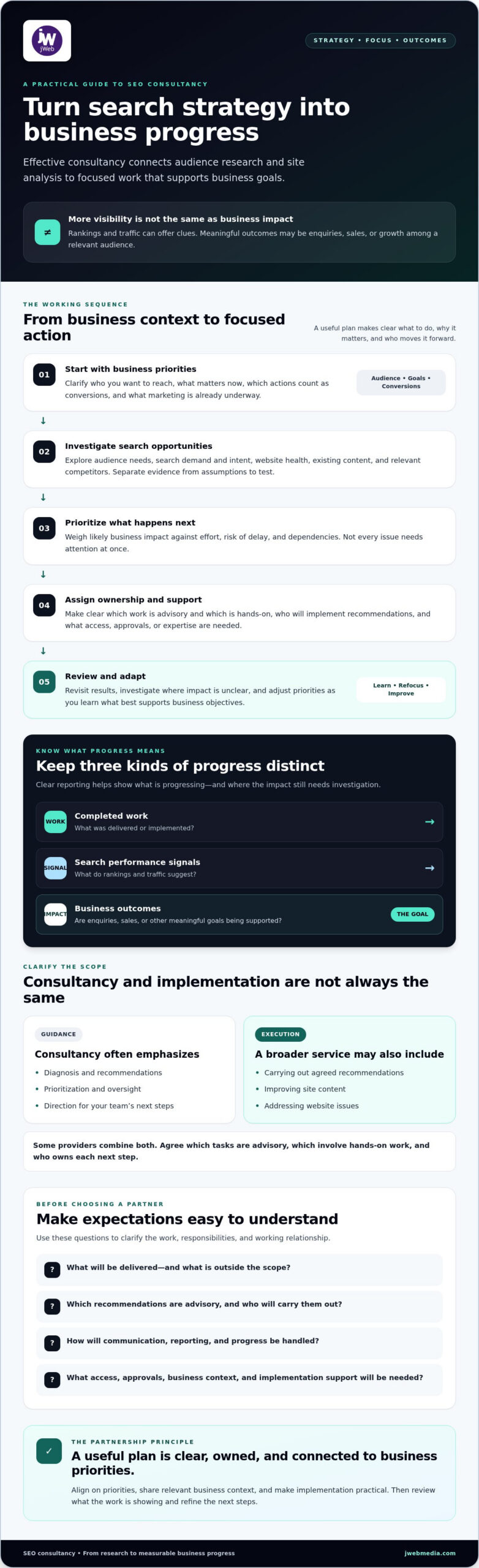
The label alone doesn’t tell you what a provider will do. Consultancy often emphasizes diagnosis, recommendations, prioritization, and oversight. A broader service arrangement may also include carrying out the work, such as improving site content or addressing website issues. Some providers combine both. Before engaging, clarify which tasks are advisory, which involve hands-on execution, and who owns each next step.
The best fit depends on your team’s skills, capacity, and priorities. If you have people ready to implement changes, expert direction may be enough. If your team lacks time or relevant experience, you may need a partner that can also deliver agreed work. Clear scope helps prevent a useful plan from becoming an unowned to-do list.
When a business may benefit from SEO guidance
SEO consultancy can be useful when you’re planning growth, seeing customer demand shift, preparing for a website change, or struggling to understand what organic performance means. It can help your team decide what to investigate before committing time and resources, and how search priorities relate to customer needs.
That doesn’t mean every business needs an outside consultant. Start by identifying the decision you need help with. A focused review may help clarify next steps; ongoing advice or implementation support may make sense if your needs and internal capacity call for it. Agree on the purpose first, then choose a scope that fits.
How an SEO consultant turns research into a prioritized action plan
Research becomes useful when it helps your team make decisions. A thoughtful seo consultancy process connects business priorities to search opportunities, then sequences the work so people know what to do, why it matters, and who will move it forward. An effective SEO strategy also needs to fit the people, budget, and systems available to deliver it.
From business goals to search opportunities
Start with the business: who you want to reach, what matters now, which actions count as conversions, and what other marketing activity is already underway. Keyword and search-intent research can then reveal the questions customers ask and whether your pages address them clearly. A consultant should distinguish evidence, such as relevant search demand or a clear site issue, from assumptions that need testing.
From there, research can examine audience needs, search demand, website health, existing content, and relevant competitors. The goal isn’t to fix every issue at once. A recommendation’s value depends on its likely business impact, the effort required, the risk of delay, and whether other work must happen first. Improving an important page, for example, may depend on technical changes or approval from a subject-matter expert.
An unranked audit tells you what may be wrong; a prioritized plan shows what to do next, why it matters, and what must happen first.
From recommendations to implementation
A practical action plan turns findings into owned tasks. For each recommendation, clarify its rationale, priority, dependencies, responsible owner, and how progress will be assessed. That way, technical fixes don’t sit in a report without an implementer, and content updates don’t stall while teams wait for approvals.
- 1. Discover: Agree on customers, business goals, conversion actions, and current marketing context.
- 2. Diagnose: Review audience needs, search demand, site health, content, and relevant competitors.
- 3. Recommend: Rank actions by expected value, effort, risk, and dependencies. Separate evidence-backed opportunities from ideas to investigate.
- 4. Implement: Assign technical fixes, content changes, approvals, and measurement to the right people.
- 5. Review: Check what changed, learn from the results, and adjust the next priorities.
Content priorities should reflect what your audience needs and what the business can credibly provide. A guide to SEO content strategy can help your team think through how planned content supports search visibility and audience needs. Keep the work collaborative: the consultant brings analysis and recommendations, while your team provides business context, access, approvals, and implementation support. The scope should make those responsibilities clear.
How to measure SEO consultancy beyond rankings and traffic
Useful reporting starts with the business goal and conversion actions agreed during discovery. If the priority is qualified enquiries, track whether organic visitors take meaningful steps, not just whether more people arrive. If the goal is sales, connect search activity with relevant purchase actions where your measurement setup allows.
SEO reporting is most useful when it pairs visibility measures with on-site behavior and business outcomes, so you can see what’s changing and whether that change supports your goals. Rankings and organic sessions provide context, but they don’t prove that search work is attracting the right audience or contributing to business growth.
Which SEO metrics belong in a useful report?
Use a consistent set of measures and define them clearly. Google Search Console can show how often pages appear in search and earn clicks. Google Analytics 4 can help assess what visitors do after arriving, including landing-page engagement and tracked conversions. Together, they provide different views of the path from search visibility to action.
Activity: Work completed, such as publishing or updating content and addressing agreed site issues.
Search indicators: Organic impressions, clicks, rankings, and sessions. These show visibility and visits, not whether the visits are valuable.
Business outcomes: Conversions and qualified lead trends, interpreted against the conversion actions your business has defined.
Compare like with like: use consistent date ranges, conversion definitions, and reporting methods. Attribution has limits. A customer may discover a business through organic search, then return later through another channel before enquiring or buying. Treat the numbers as evidence to interpret alongside sales and customer context, not as a perfect record of what caused each outcome.
How to interpret progress without expecting instant results
SEO outcomes depend on factors such as competition, site condition, available resources, and how quickly agreed changes are implemented. Early signals might include completed work, improved indexing, or changes in impressions and clicks. Business outcomes, such as a sustained shift in qualified enquiries, may take longer to assess and can be affected by factors beyond search.
Agree on a baseline and review progress over consistent periods. If visibility improves but relevant conversions don’t, investigate whether the pages match search intent, whether visitors can take the next step, and whether conversion tracking is working. If actions are delayed, report that too; incomplete implementation can make performance difficult to interpret. There’s no universal timeline that fits every site or business.
If you’re weighing different provider arrangements, compare their scope, responsibilities, and approach to reporting before deciding what fits your team.
How to evaluate an SEO consultancy relationship before committing
A productive seo consultancy relationship starts with a clear understanding of your business and the work you can realistically support. Before agreeing to a scope, check whether the provider can explain how they’ll learn about your customers, business goals, website constraints, and existing marketing. Strong answers should connect that context to specific priorities, not arrive as a one-size-fits-all checklist.
Questions that reveal a consultant’s approach
Use these questions to understand what the engagement will involve and how you’ll work together:
- How will you learn about our customers, priorities, website, and current marketing?
- What findings and deliverables should we expect, and how will you explain why one recommendation comes before another?
- Who will own technical fixes, content updates, approvals, and measurement?
- How will you share progress, and what will reports help us decide?
- How would you adjust the plan if results, new evidence, or business priorities change?
Ask for clarity on communication and reporting before work begins. You should understand who your main contact is, how decisions are handled, and what information your team needs to provide. The exact arrangement can vary, but responsibilities and expectations shouldn’t be left vague.
Red flags and realistic expectations
Be cautious of guaranteed rankings, methods a provider won’t explain, or reports that list completed tasks without interpreting what they mean. Experience claims and case studies can help you ask better questions, but they can’t establish that the same outcomes will happen for your business. Ask what conditions supported those results and what might differ in your situation.
There’s another practical test: can your team act on the recommendations? Advice has limited value if no one has the expertise, time, or authority to implement it. If you have internal capacity, advisory work and oversight may suit you. If not, clarify whether implementation is included or who will take responsibility for it. A credible provider will discuss dependencies and uncertainty rather than promise exact outcomes.
Use the conversation to judge whether the proposed scope fits your resources and priorities. jWeb Media offers SEO alongside services such as content marketing, paid advertising, and custom website design, which may be relevant when search work needs to connect with other marketing or website priorities. To discuss how your business goals could shape a search approach, talk with jWeb Media about your goals.
What an effective SEO consultancy partnership looks like in practice
An effective seo consultancy partnership isn’t a report delivered and filed away. It’s a shared cycle: agree on priorities, carry out the work, review evidence, learn what’s changing, and adjust the next steps. That rhythm helps keep search activity connected to business goals as customer needs and internal priorities evolve.
What clients and consultants each contribute
The consultant contributes analysis, recommendations, clear communication, and any execution included in the agreed scope. The client brings knowledge the consultant can’t get from search data alone: customer questions, product or service priorities, business constraints, and insight from sales or customer-facing teams.
Progress also depends on practical support from the client. Provide agreed access to relevant website and analytics information, assign people to review recommendations, and arrange approvals or implementation resources. If the consultant advises on a website improvement but no one can schedule it, the work can stall. Make responsibilities explicit so recommendations don’t get lost between teams.
Coordination matters, too. A website change may need to account for search priorities, while content marketing can address questions customers are actively researching. Paid search can complement organic work when a business wants to reach searchers through ads as well. If those channels are part of your plan, review the approach to PPC management services and decide how paid and organic efforts should support the same business objectives.
A practical next step for exploring SEO consultancy
Before speaking with a potential partner, write down four things: your business goals, current search or website challenges, internal capacity to act on recommendations, and the customer actions you want to encourage. This gives both sides a clearer starting point and helps identify whether you need strategic guidance, implementation, or a combination.
jWeb Media offers SEO alongside custom website design, content marketing, and paid advertising, so its wider marketing capabilities may be relevant if your priorities cross channels. Fit depends on your goals, scope, and available resources; no particular outcome is guaranteed. If you’re ready to explore how search work could support your priorities, discuss your marketing goals with jWeb Media.
Turn your search strategy into purposeful growth
Effective seo consultancy connects research to the work your business can actually act on. The right partner helps prioritize opportunities, clarify who owns implementation, and measure progress against meaningful business outcomes. Rankings and traffic matter as signals, but they’re most useful when viewed alongside relevant enquiries, sales, or other conversion actions.
A productive relationship also depends on shared responsibility. Bring your knowledge of customers, goals, and internal capacity; expect clear recommendations, transparent communication, and reporting that helps guide decisions. With that foundation, SEO can work in step with content, website improvements, and other marketing priorities.
jWeb Media is an independent digital agency founded in 2004. Its services include SEO, content marketing, website design, paid advertising, and social media management, creating options for businesses considering how search fits into their wider marketing plans.
Ready to explore what a practical search strategy could look like for your business? Discuss your SEO goals with jWeb Media and take the next step with confidence.
Frequently Asked Questions
What does an SEO consultant do?
An SEO consultant assesses how well a website serves searchers and identifies opportunities to improve organic visibility. Depending on the agreed scope, the work may include research, technical and content analysis, recommendations, implementation support, and performance reviews. Before engaging someone, clarify whether they’ll advise your team, carry out work directly, or combine both. Provider labels aren’t always consistent, so a clear description of responsibilities matters more than the title.
Is SEO consultancy worth it for a small business?
SEO consultancy can be worthwhile when search visibility supports a clear business goal and your team needs expertise or help setting priorities. Its value depends on the opportunity, the usefulness of the recommendations, your ability to implement them, and how you assess outcomes. Start by defining what you want to improve, such as relevant enquiries or online sales. Then agree on how progress will be evaluated before committing resources.
How long does SEO consultancy take to show results?
There’s no reliable timeline that applies to every business. Progress depends on factors such as your website’s starting condition, the competitive environment, the work required, and how quickly recommendations are implemented. Ask a consultant to explain their assumptions, which early indicators they’ll monitor, and when you’ll review progress. A responsible practitioner will discuss uncertainty and changing priorities rather than guarantee rankings or promise a specific outcome date.
What is the difference between SEO consultancy and an SEO agency?
SEO consultancy often focuses on diagnosis, strategic guidance, and recommendations, while an agency may offer a broader team or ongoing execution. In practice, the terms overlap: consultants may implement work, and agencies may provide advisory support. Compare what’s actually included instead of relying on the label. Clarify responsibilities, communication, reporting, and whether your team or the provider will complete technical updates, content changes, and other agreed actions.
How can I measure whether SEO consultancy is working?
Start with agreed business goals and a baseline, then review relevant search visibility and organic visits alongside meaningful actions, such as qualified enquiries or purchases. Google Search Console can show search impressions and clicks, while Google Analytics 4 can help assess on-site activity and tracked conversions. These tools measure different things, and attribution isn’t perfect. Useful seo consultancy reporting explains what changed, how it relates to your goals, and what to consider next.
What should I ask before hiring an SEO consultant?
Ask how the consultant will learn about your customers, goals, website, and existing marketing. Clarify what analysis and recommendations are included, who will implement them, and how communication and reporting will work. Discuss any access or approvals your team must provide, and ask how priorities may change as evidence emerges. Relevant experience can inform your questions, but past results don’t guarantee yours. Be cautious of guaranteed rankings or unexplained methods.
Can SEO consultancy work alongside paid search?
Yes. Organic and paid search can contribute to broader marketing goals through different channels and approaches. Teams may coordinate audience insights, landing-page priorities, or campaign learnings where it makes sense, while still defining each channel’s role and measuring it appropriately. Whether coordination is useful depends on your objectives, resources, and marketing setup. Agree on how the channels support your priorities so combined activity stays purposeful rather than duplicating effort.