


A strong digital marketing RFP template makes agency proposals easier to compare by clearly stating your goals, scope, deliverables, budget, timeline, and submission requirements. It also gives agencies the context to develop a relevant response, including what is working in your digital presence and where you need support. Clear details help you judge whether each proposed approach fits the work you need.
It’s easy to list the services you want without defining their boundaries. When SEO, PPC, social media, website work, eCommerce, or video is part of the request, spell out expectations. Doing so clarifies what is included, how success will be assessed, and how you will evaluate proposals.
This guide shows you how to build an RFP around your business goals, separate must-haves from out-of-scope work, and define practical deliverables, budget parameters, timelines, and submission instructions. It also explains how to tailor the request to different digital marketing services, so agencies can present a clear plan and you can compare proposals on equal terms.
Key Takeaways
- Describe your current digital presence and business goals so agencies can shape proposals around the challenges you need to solve.
- Separate must-have work from nice-to-haves and out-of-scope tasks to make deliverables and responsibilities clear.
- Set a budget framework, decision timeline, submission requirements, and evaluation criteria before inviting proposals.
- Define your target audience and tailor the request to the channels and deliverables that support your marketing goals.
- Use service-specific requirements for SEO, PPC, social media, websites, eCommerce, or video to make proposals easier to compare.
Defining project needs, scope, deliverables, and timeline
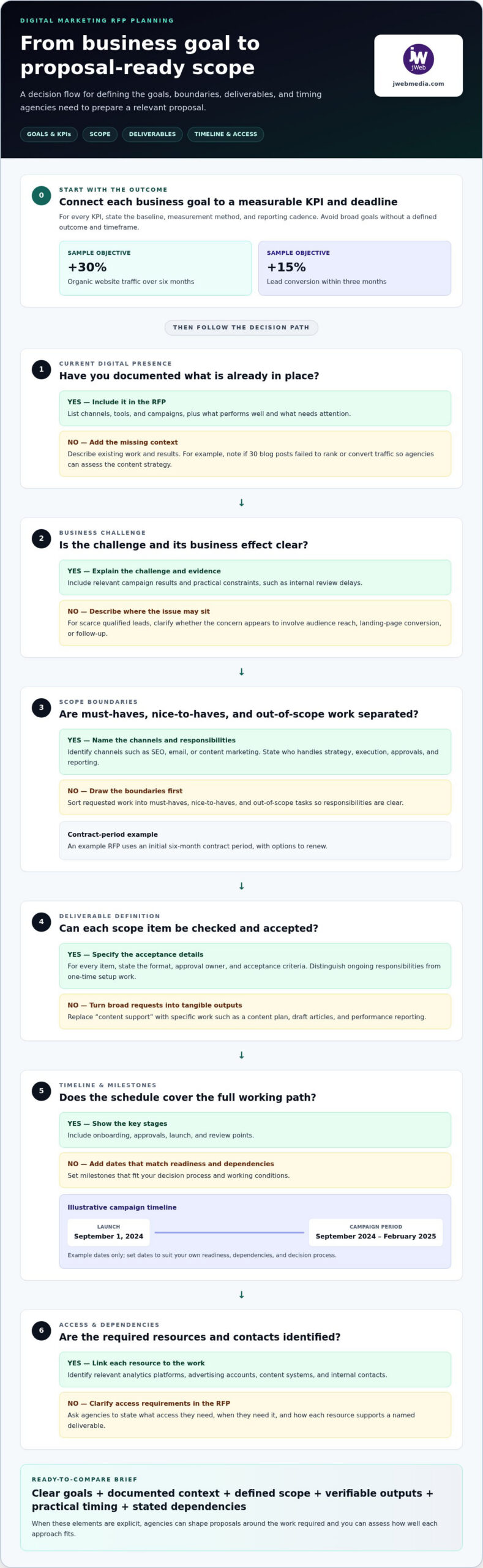
Define goals as measurable outcomes, then connect each KPI to a business priority and deadline. For example, a sample campaign objective is to increase organic website traffic by 30% over six months.
Use this walkthrough to organize the information marketing agencies need to prepare a proposal:
-
Define Marketing Goals and KPIs
Choose business goals first, then name the KPI that will show progress. For example, a sample objective increases lead conversion by 15% within three months. State the baseline, measurement method, and reporting cadence for each KPI. Avoid broad targets such as “grow online” without a defined outcome, timeframe, and connection to the organization’s priorities.
- Describe your current digital presence with specific examples. List the channels, tools, and campaigns in use, then note what performs well and what needs attention. If 30 blog posts failed to rank or convert traffic, include that history so agencies can assess the content strategy instead of proposing more of the same.
- Explain the business challenge behind the request and its effect. If qualified leads are scarce, for example, describe whether the issue appears to involve audience reach, landing-page conversion, or follow-up. Include relevant campaign results and practical constraints, such as internal review delays, so agencies can account for your working conditions.
-
Set Scope, Deliverables, and Timeline
Define the agency’s scope by separating must-haves, nice-to-haves, and out-of-scope work. Name the channels involved, such as SEO, email, or content marketing, and state who handles strategy, execution, approvals, and reporting. Set the contract period and milestones. A sample RFP uses an initial six-month contract period, with options to renew.
- Turn each scope item into a verifiable deliverable. Instead of asking for “content support,” specify the work, such as a content plan, draft articles, and performance reporting. State the format, approval owner, and acceptance criteria for each item. This helps distinguish ongoing responsibilities from one-time setup work.
- Build a timeline that covers onboarding, approvals, launch, and review points. A sample campaign timeline runs from September 2024 through February 2025, with a September 1, 2024 launch. Treat those dates as an example: set dates that match your own readiness, dependencies, and decision process.
- Clarify access and dependencies before proposals arrive. Identify the analytics platforms, advertising accounts, content systems, and internal contacts relevant to the work. Your digital marketing RFP template can ask agencies to specify what access they need, when they need it, and how each resource supports a named deliverable.
What Is a Marketing Request for Proposal (RFP)?
A marketing RFP helps an organization assess which agency fits a project. It defines the challenge, response format, and evaluation criteria so proposals address the same needs.
Include background and goals, scope and deliverables, timelines, requirements, evaluation criteria, and requests for portfolios, case studies, and references. Add legal and confidentiality terms explaining how agencies may use shared information, who owns submitted materials, and how confidential business data must be handled.
- Set a consistent proposal format. Give every agency the same response instructions, such as an executive summary, understanding of the challenge, recommended strategy, work plan, team qualifications, reporting approach, and commercial terms. A digital marketing RFP template can provide this structure while allowing agencies to explain how their approach supports your goals. Ask respondents to label assumptions and dependencies clearly.
- Request relevant evidence. Ask for two to three case studies showing comparable work, the agency’s role, the strategy used, and outcomes tied to stated objectives. Request contact information for two to three client references. This evidence helps you assess relevant experience rather than relying on broad claims or familiar industry language.
- Specify qualifications and response expectations. Ask agencies to identify the people who would work on your account, their responsibilities, and their relevant experience. Request a proposed approach, delivery process, communication plan, and explanation of how results will be measured. Strong responses address each requirement directly, distinguish recommendations from assumptions, and connect activities to your success criteria.
- Compare commercial proposals by value, not totals alone. Ask agencies to separate strategy, labor, tools, and any media investment so the proposed work is understandable. For a retainer, identify the recurring work, expected outputs, reporting, and review process. Compare the resources and deliverables behind each proposal, then note exclusions and assumptions. A PPC management proposal, for example, should make its campaign responsibilities and reporting approach clear.
- Apply published evaluation criteria. Create a scorecard before reviewing submissions, with criteria such as relevant experience, strategic fit, team capabilities, delivery approach, and commercial value. One sample RFP assigns 30% to experience, 30% to strategy, and 20% to pricing. Treat those weights as an example, not a required formula, and define how your organization will assess the remaining criteria.
- Manage the selection process consistently. State how agencies may submit questions, when responses will be shared, and how proposals will be reviewed. Choose about 20 important questions aligned with your goals instead of asking every possible question. Keep clarification answers available to all participants, and record how each proposal meets the same requirements. This creates a clearer basis for comparing recommendations and selecting a partner.
Budget, timelines, and submission instructions
Set the budget framework and selection calendar before sending the RFP. Clear dates and submission rules help marketing agencies plan their responses and let your team compare proposals consistently.
-
Set the RFP Timeline and Budget
Publish the proposal deadline, selection date, expected agreement date, and anticipated start. One sample RFP sets July 15, 2024, as the submission deadline and August 1, 2024, as the agency selection date. Use your own calendar, allowing time for questions, proposal review, approvals, and agreement discussions.
- State whether your budget covers agency work, media spend, tools, or production. A sample RFP budget distinguishes a monthly allocation that includes ad spend from service fees. This helps respondents explain what their proposed resources cover. If you have a firm ceiling, share it. If you’re comparing approaches, provide a useful range or explain how agencies should present options.
-
Provide Submission Instructions
Specify the required file format, delivery method, naming convention, and exact deadline. One sample instruction sets the deadline at 5:00 PM CST on the due date. State whether late or incomplete proposals will be considered, and give agencies a designated contact for questions. Require questions no later than two (2) business days before the submission date.
- List response components in a fixed order, such as approach, team, work plan, deliverables, assumptions, and budget. Specify whether agencies should submit one combined document or separate files. A consistent format reduces avoidable differences, so evaluators can focus on each proposal’s solution rather than its layout or missing sections.
- Show the evaluation and decision process. Explain who will review proposals, which criteria matter, whether presentations or follow-up discussions are planned, and when finalists can expect an update. For example, an August 1 selection date gives respondents a clear decision milestone after a July 15 deadline. Include the expected timing for agreement review and project kickoff.
- Set an appropriate proposal-validity period and explain what it means. One example RFP asks agencies to keep proposals valid for 90 days. This gives the organization time to complete review and internal approvals while keeping the proposed scope and commercial terms available. State how agencies should identify any assumptions that could affect deliverables or the proposed schedule.
- Check that your calendar accounts for the work itself. A September 1, 2024 campaign launch, for instance, requires enough time beforehand for onboarding, account access, content approvals, and campaign preparation. Align the start date with those dependencies, then give agencies a realistic schedule for each decision and handoff.
What Is a Digital Marketing RFP?
A digital marketing RFP connects a business challenge with an audience, market context, and proposed work. Use it to explain whom your organization needs to reach and what may prompt those people to respond.
- Describe your ideal customer profile. Identify the traits that distinguish a strong-fit customer, such as location, needs, buying role, and purchase priorities. A sample audience might include homeowners aged 35 to 65 with incomes of $50,000 or more. Treat those details as an example, then tailor the profile to your own market and offer.
- Build buyer personas from real customer details. For each priority audience, describe the problem they want to solve, what influences their selection, and what information helps them decide. For example, a homeowner comparing renovation options may want evidence of quality, clear service details, and an easy way to request information. Separate documented customer insights from assumptions so agencies can tell evidence from hypotheses.
- Explain the market context. Describe the regions you serve, the customer need you address, and factors that influence demand or buying decisions. If your organization serves customers nationally, clarify whether the campaign targets the full market or selected communities. Include relevant shifts, seasonality, or sales patterns only when your team can explain how they affect audience reach or campaign planning.
- Name relevant competitors and examples of effective marketing. List several competitors, then identify campaigns, messages, or customer experiences your team found effective. Explain what stands out, such as a useful comparison guide or a clear landing page, rather than asking an agency to copy it. This helps respondents understand your preferences while leaving room for an original strategy.
- Map the buying group and decision journey. Note who influences selection, who approves a purchase, and what information each person needs. Gartner research says a typical buying group for a complex B2B purchase involves six to ten decision makers. For a business sale, specify whether a technical lead, finance reviewer, and executive sponsor each shape the final decision.
- Connect audience insight to campaign choices. Ask agencies to explain how audience profiles inform their channel, message, and content recommendations. A digital marketing RFP template can prompt respondents to distinguish customer segments, describe the evidence behind their choices, and show how they would address different needs. This makes it easier to judge whether each tactic fits the people you want to reach.
SEO, PPC, social media, website, eCommerce, and video RFP templates
Adapt the document to each channel, then define the specific work, inputs, and outputs agencies should address.
Use one shared response format across these channel-specific sections, then compare scope and deliverables side by side. If paid campaigns are part of your plan, explore PPC management as a possible fit for the work.
JWeb Media: Custom Website Design
jWeb Media can support businesses whose RFP includes custom website design, SEO, social media management, or PPC management. If your scope combines website improvements with marketing activity, define how those workstreams connect to your goals and customer journey. For example, a website redesign may support search visibility and turn relevant visits into inquiries.
Bring a draft scope to jWeb Media when you’re ready to shape your requirements into a practical project plan. Clear priorities help align website design and digital marketing work with the audience you want to reach.
Contact jWeb Media to discuss your project.
Turn your RFP into a focused next step
Once your draft is ready, involve the people who will evaluate proposals. Agree on what a strong working relationship looks like, which trade-offs matter, and how your team will make decisions. That shared understanding helps keep the project focused on your organization’s priorities after selection.
Use your digital marketing RFP template as a starting point, not a substitute for conversation. Discuss how your goals connect with your website and the ways customers find and engage with your business. jWeb Media offers Custom Website Design, Search Engine Optimization (SEO), and Social Media Management to support those needs.
If you’re ready to shape your project requirements into a practical plan, contact jWeb Media about your RFP. A clear conversation can help you move from planning toward a partnership built around your business goals.
Frequently Asked Questions
Where can I download a free marketing RFP template?
Create a free version by copying this guide’s framework into a document and tailoring it to your project. Use it as a working file, remove sections that don’t apply, and add fields for internal approvals or required attachments. Keep a clean master copy and a project-specific version, so future teams can reuse the structure without carrying over outdated goals or dates.
What questions should a digital marketing RFP template ask prospective agencies?
Ask agencies how they would investigate your challenge before recommending tactics. Request details about who would lead the work, how they would coordinate with your team, and what information they need to begin. Ask how they handle changing priorities and explain performance when results shift. A strong response clarifies who reviews campaign data and how recommendations move from analysis to approved action.
How do you write the scope of work for a digital marketing RFP?
Define the scope as a boundary between included work and related tasks your organization will handle. For example, specify whether a content project covers planning and writing only, or also publishing and updates. Identify the internal approval owner and the materials your team will supply. Add a process for reviewing changes, so a new request does not become an assumed deliverable.
What information should an RFP include about budget and pricing?
Explain how respondents should organize costs and what the budget must cover. Ask them to distinguish recurring work from one-time setup and identify assumptions that could change the proposal. For example, have each agency state whether tools, content production, or media investment are included in its estimate. Request optional recommendations separately, so your team can compare the core scope without confusing it with add-ons.
How should agencies be evaluated and scored in a digital marketing RFP?
Use a shared evaluation sheet and record evidence alongside each rating. Assess whether the proposal addresses your business challenge, explains its recommendations, identifies the people doing the work, and clearly assigns responsibilities. Have reviewers score independently before discussing differences. Ask each reviewer to cite the proposal section that supports a rating, rather than relying on presentation style or a memorable pitch.
What is the typical timeline for issuing and reviewing a marketing RFP?
Build the calendar backward from your desired project start, allowing time for preparation, agency questions, proposal review, decision approvals, and agreement discussions. The time required depends on how many stakeholders review submissions and how complex the work is. A website redesign with several approval teams, for example, needs more coordination than a focused campaign with one decision owner.
How do RFP requirements differ for SEO, PPC, social media, and full-service marketing?
Each RFP should request evidence suited to the work. For SEO, ask how recommendations will be prioritized across technical and content needs. For PPC, clarify campaign management and reporting responsibilities. For social media, define account access, publishing approvals, and community boundaries. A full-service digital marketing RFP template should also explain how channels connect, who coordinates dependencies, and how progress will be reported. For example, when evaluating firms like H&O Consulting that build integrated customer acquisition systems, look for clarity on how cross-channel strategies work together to turn prospects into customers.