


The best response to a negative comment is calm, prompt, and focused on a useful next step. Knowing how to handle negative comments on social media means acknowledging a legitimate concern, apologizing when your business made a mistake, and offering a practical way to resolve it. Whenever possible, respond within 24 hours, and don’t delete fair criticism simply because it’s uncomfortable.
A public complaint can feel like a threat to your reputation, but it can also reveal what a customer experienced, where expectations fell short, or what needs attention. The reason behind the comment matters: respond thoughtfully to honest criticism, while a troll’s provocation may be better left unanswered.
This guide explains why negative comments matter, how to distinguish useful feedback from trolling, and when to apologize. You’ll also learn how to respond without getting defensive, move sensitive details to a private conversation, and use recurring feedback to improve your products, services, and customer experience.
Key Takeaways
- Respond calmly and promptly, and create a clear process for handling complaints and escalating serious concerns.
- Acknowledge valid criticism, apologize when your business is at fault, and explain the next step toward resolving the issue.
- Look for the intent and substance behind a comment before deciding whether to engage, moderate, or leave it unanswered.
- Track recurring complaints to spot opportunities to improve your products, services, and customer experience.
- Understand common reasons customers speak up so your responses address the underlying problem, not just the public comment.
1. Why are Social Media Comments Important?
A public complaint gives a business a chance to understand what went wrong and respond where other customers can see. According to a Sprout Social study, 86% of Americans said company transparency is more important than ever. A prompt, respectful reply can show that the concern has been heard, while silence can leave readers without the business’s perspective.
Ignoring or deleting a negative comment can leave a customer feeling dismissed and a public complaint unanswered. Removing fair criticism can also weaken trust, especially if others have already seen or shared it.
To assess whether replies help resolve complaints, track whether the customer confirms the issue is resolved, whether the conversation becomes more constructive, and whether similar complaints recur. Compare these signals across similar concerns, such as delayed orders or confusing instructions, rather than relying on likes alone.
A response plan helps your team act consistently instead of improvising under pressure. Decide who monitors comments, who can reply, and which issues need escalation. For example, a support team might handle a delivery concern, while a safety complaint goes directly to the manager responsible for that issue.
- Assign an owner to review each platform and route comments to the right team.
- Set response guidance for routine complaints, sensitive concerns, and possible crises.
- Give responders approved next steps, such as acknowledging the issue and inviting the customer to continue privately.
- Record the concern, the action taken, and whether the customer received a resolution.
Monitoring needs a schedule, not just an alert tool. Check each social channel regularly, including nights and weekends when the business is active there, and manually review feeds so a missed notification doesn’t hide a concern. When possible, respond within 24 hours; if investigation takes longer, acknowledge the comment and explain when the customer can expect an update.
Decide whether to respond, ignore, or delete based on the comment’s content. Reply calmly and briefly to a specific complaint, and move personal details or account questions to a private conversation. Repetitive provocation with no genuine issue may not warrant engagement; spam or abusive content may need moderation. Don’t argue or ask customers to remove fair criticism.
A respectful reply keeps the focus on the concern, not the conflict. Acknowledge the customer’s experience, explain the next step, and avoid defensive language. For example, “We’re sorry this caused frustration. Please send us a private message so we can look into the order” shows care without exposing personal information publicly.
2. Acknowledging legitimate criticism and apologizing
A useful apology begins with listening to what the customer actually experienced. Read the full comment, identify the specific problem, and acknowledge its impact before explaining what happens next. If someone says a confusing return process wasted their time, address that frustration directly instead of offering a generic “sorry you feel that way.”
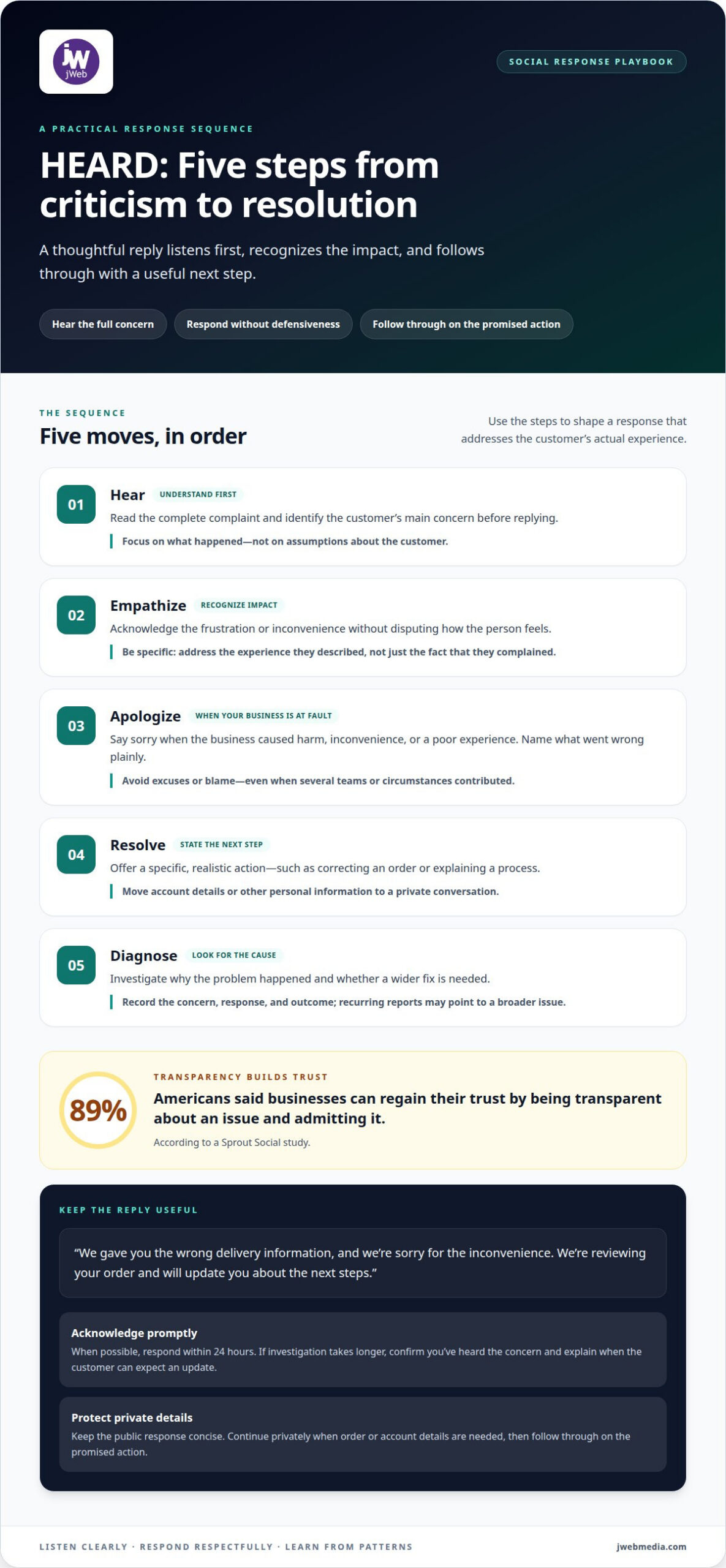
When your business made a mistake, say so plainly. Name what went wrong, recognize the inconvenience, and outline a realistic action to address it. Avoid excuses or blame, even when several teams or circumstances contributed. For example: “We gave you the wrong delivery information, and we’re sorry for the inconvenience. We’re reviewing your order and will update you about the next steps.”
According to a Sprout Social study, 89% of Americans said businesses can regain their trust by being transparent about an issue and admitting it. Transparency doesn’t mean sharing private customer information in a public reply. It means stating what the business understands, what it’s doing, and what information it still needs to resolve the complaint.
The HEARD technique offers a practical sequence for a considered response:
- Hear: Read the complete complaint and identify the customer’s main concern.
- Empathize: Acknowledge the frustration without disputing the person’s feelings.
- Apologize: Say sorry when the business caused harm, inconvenience, or a poor experience.
- Resolve: Offer a specific next step, such as correcting an order or explaining a process.
- Diagnose: Look into why the problem happened and whether a wider fix is needed.
For example, a customer who reports receiving a damaged item needs more than “We’re sorry.” A stronger reply acknowledges the damage, moves the conversation to private messages if order details are needed, and explains how your business will review the issue. Keep the public response concise, then follow through on the promised action. An apology without action can deepen frustration.
Assess feedback before deciding what to change. Separate the customer’s account from assumptions, check relevant records, and involve the team responsible for the product, service, or policy. One complaint may reveal a clear process failure; repeated reports about the same confusing instruction may point to a broader issue. Record the concern, response, and outcome so patterns can inform decisions.
Acknowledge complaints promptly, even when a complete answer requires investigation. A brief message can confirm you’ve heard the feedback and explain when the customer can expect an update. This gives your team time to gather accurate details without leaving the customer unsure whether anyone is taking action.
3. How can a business differentiate between constructive criticism and trolling?
Negative comments generally fall into two categories: criticism and trolling. First, ask whether the message describes a specific experience or problem. “The checkout page froze when I tried to pay” gives your business something concrete to investigate. A stream of insults with no clear concern offers little actionable feedback.
Constructive criticism can sound angry and still point to a genuine issue. Look for details about a product, service, interaction, or process, then consider whether the commenter is asking a question or seeking a resolution. For example, “My appointment was canceled without notice” identifies a possible service failure, even if the customer’s tone is sharp.
Trolling tends to provoke a reaction rather than explain a negative experience. Repeated personal attacks, deliberately inflammatory remarks, or messages that shift topics whenever your business responds may indicate that productive discussion isn’t the goal. One rude sentence alone doesn’t prove intent, so assess the context and the message as a whole.
Before responding, use a simple review process:
- Identify the claim: Is there a specific product, service, or interaction to investigate?
- Check the context: Could a typo, missing detail, or ambiguous phrase change the message’s meaning?
- Look for a useful next step: Can the business answer, correct an error, or ask a relevant follow-up?
- Choose a response: Address a genuine concern, or avoid feeding a comment that only seeks conflict.
A comment can be mistaken without being trolling. If a customer says a promotion ended early, check the advertised terms before replying. Correct inaccurate information calmly and provide the relevant detail. Avoid sarcasm or public arguments, which can distract from the facts and turn a misunderstanding into a wider dispute.
Keep a troll’s opinion in perspective. A provocative message reflects one person’s behavior, not the full customer experience. Staff should avoid taking the bait, trading insults, or repeatedly replying to someone who ignores useful answers. A concise moderation response may help when other readers need clarification; otherwise, disengaging prevents the exchange from taking over.
Handle false claims, spam, threats, and abusive comments according to their content. Correct a false factual claim with clear information, and use the platform’s moderation tools to remove or report spam. Report comments involving harassment, threats, violent undertones, or racist or homophobic language. If harassment escalates, save screenshots and other documentation. Protect your community without treating good-faith criticism as abuse.
4. Using negative feedback to improve products and services
A complaint can reveal a problem that routine reviews miss. A customer who says product instructions are confusing may be pointing to unclear wording, not a defective item. Treat comments as evidence to investigate, not proof that every proposed fix is right. Aim to understand the situation, identify what your business can change, and follow through sincerely.
Start by grouping feedback into themes such as product quality, service delays, confusing policies, or communication gaps. Record the platform, date, issue, and outcome in a shared log. If customers across social channels repeatedly describe the same checkout difficulty, the pattern may warrant a usability review. Keep individual comments accessible too, since summaries can hide important context.
Turn each recurring theme into a clear improvement question:
- Product: Do reports of a loose lid point to a design or quality-control issue?
- Service: Do complaints about missed updates show that customers need clearer progress messages?
- Process: Do questions about returns suggest that instructions are difficult to find or understand?
- Communication: Do customers misunderstand an offer because marketing language leaves out a key condition?
Next, bring the feedback to the team best placed to assess it. Customer service can explain what customers asked; product or operations staff can examine the relevant design or process. Before rewriting a return policy, for example, review the questions customers raise and the steps they struggle to complete. That context helps address the cause, not just the visible symptom.
Not every suggestion calls for a change. Consider how often the issue appears, how much it affects customers, and whether a proposed fix could create new problems. A single request for an unusual product feature may be worth recording, while repeated reports of a broken ordering step deserve closer attention. Document the decision and its reasoning so feedback leads to deliberate action.
Close the loop when a change addresses a customer’s concern. In a public reply, thank them for raising the issue and describe the improvement without overstating its impact. If the fix takes time, provide a clear update when there’s meaningful progress. Following through sincerely shows that feedback informed the decision, even when your business can’t adopt every suggestion.
Review the feedback log regularly and compare new comments with earlier themes. If complaints about unclear instructions decline after a rewrite, that’s a practical sign the change may be helping. Keep listening across channels, since customers may describe the same experience differently on social media, in support conversations, or through direct feedback.
5. Common reasons customers post negative comments
A negative post often starts with a gap between what a customer expected and what happened. They may mention a late delivery, unclear instructions, a product that didn’t work as expected, or an interaction that felt dismissive. Identify the underlying cause so your response addresses the experience, not just the public wording.
Product and service problems are common reasons customers speak up. Someone might report that an item arrived damaged, a booking was canceled, or a service didn’t match its description. Each situation needs a different investigation: review fulfillment records for shipping complaints, or examine the service details when expectations and delivery don’t align.
Communication gaps can turn a manageable issue into a negative experience. A customer may post after waiting for an update that never arrived or finding a key condition unclear in a promotion. Trace the communication across the customer journey, from the original marketing language to the order confirmation and follow-up.
Some complaints reflect a deeper breach of trust, especially when a business’s actions affect people or communities. In 2018, two men were wrongfully arrested in a Philadelphia coffee shop, prompting backlash against the company. The example shows why public criticism may concern more than an individual transaction: people can react to how a business treats customers and addresses harm.
Customers may also post because other contact channels didn’t resolve their concern. Someone who has already contacted support may use a public platform to seek acknowledgment or visibility. That doesn’t make every complaint accurate, but it does give your business a reason to review earlier interactions before asking the person to repeat the same information.
- Expectation mismatch: Compare what the customer understood with the product description, policy, or promise they saw.
- Quality or delivery issue: Check the item, order, or service records connected to the complaint.
- Unclear communication: Review whether instructions, updates, or marketing messages left room for confusion.
- Trust or conduct concern: Consider who was affected and whether the response addresses the wider impact.
- Unresolved support request: Look at previous messages and identify where the conversation stalled.
Reviewing recurring comments can reveal how different causes connect. If customers repeatedly mention unclear product instructions and frequent support requests, improving the instructions may address both. Respond effectively by first understanding why the customer commented, then matching your next action to the problem. This helps distinguish a one-time service lapse from a pattern that needs attention.
JWeb Media: Social Media Management
jWeb Media provides Social Media Management for businesses seeking a consistent, considered presence across their social channels. If comments are becoming difficult to track or responses feel disconnected from your brand’s voice, management support can bring day-to-day communication into clearer focus.
Thoughtful social media management connects audience feedback with how your business communicates online. It supports a deliberate approach to responding to concerns, recognizing recurring themes, and aligning interactions with broader marketing goals. The right approach depends on your audience, platforms, and the support your team needs.
If you’d like support managing your social media presence, contact jWeb Media to discuss your goals.
Make every response part of a stronger customer relationship
Every public response shapes how people experience your business, including customers who never comment. Knowing how to handle negative comments on social media can turn a tense exchange into an opportunity to listen, learn, and build trust through consistent communication.
Make that care part of your wider digital presence. jWeb Media offers Social Media Management alongside Custom Website Design and Search Engine Optimization (SEO), helping businesses support how customers discover and engage with them online. If your team needs a steadier approach to social conversations or wants to connect social media with broader digital goals, contact jWeb Media to discuss the next step.
Contact jWeb Media to discuss your social media and explore an approach that fits your business. With a clear plan and a willingness to learn from customers, you can meet difficult comments with care and keep moving forward.
Frequently Asked Questions
But Why Negative Comments?
Customers post negative comments to be heard, share an experience, or warn others about a problem. A public post may seem like the clearest option when a customer hasn’t received a useful answer through another channel. Someone might comment beneath a product announcement because that’s where they noticed your business. Treat the message as a prompt to understand the customer’s perspective, not as a complete account of what happened.
Why are Social Media Comments Important?
Social media comments show how people respond to a business in their own words. Use them to spot confusing announcements, recurring questions, or misunderstandings about an offer. If users keep asking whether an event requires registration, for example, clarify that detail in the post. Other readers can see how your business communicates, so a thoughtful public exchange provides useful context.
How can a business differentiate between constructive criticism and trolling?
Consider whether the message raises a specific, verifiable concern and whether the person engages with a relevant answer. A customer who explains which step failed may be offering useful feedback, even if the wording is blunt. Someone who ignores clarifying questions and keeps changing the accusation may be seeking conflict. Don’t infer intent from one short message; assess the words, context, and follow-up together.
How should a business first respond to a negative comment online?
Begin with a brief acknowledgment that shows you understood the specific issue. For example: “Thanks for telling us the booking page showed the wrong date. We’re looking into the information displayed.” Avoid a canned response that could apply to any complaint. If you need details, ask only for information that helps you investigate, and keep order numbers, account information, and other personal details out of the public thread.
OK, so you’ve gotten a negative comment or four—now what?
When several comments arrive at once, pause before replying to each one separately. Group them by topic, such as an unclear promotion or service interruption, then decide which concern needs attention first. A clear process for how to handle negative comments on social media helps your team assign responsibility and track follow-ups. If comments describe different experiences, address those differences rather than posting one broad statement that leaves people feeling overlooked.
How should you respond to negative comments on social media?
Write a calm, focused reply that addresses the commenter’s concern and gives a clear next step. Knowing how to handle negative comments on social media starts with responding to the issue raised, not defending your business in general. If someone says an advertised item wasn’t available, for example, explain how you can clarify the listing or help with that purchase. Don’t promise an outcome before reviewing the details.
When should you reply publicly versus take the conversation to private messages?
Reply publicly when a brief acknowledgment or general clarification can help the commenter and other readers. Move to private messages when resolving the issue requires personal details, account access, or a detailed exchange. Leave a public note inviting the person to message you so they know you haven’t ignored the concern. You can share a general update publicly afterward without revealing private customer information.
How quickly should a business respond to negative social media comments?
Respond as soon as your team can provide a thoughtful acknowledgment, and prioritize urgent issues affecting safety, access to services, or multiple customers. If the facts aren’t clear yet, say you’re reviewing the concern and provide a realistic update point. Don’t let the search for a complete explanation prevent a simple acknowledgment. A regular monitoring routine helps the right person see comments before they go unanswered.