

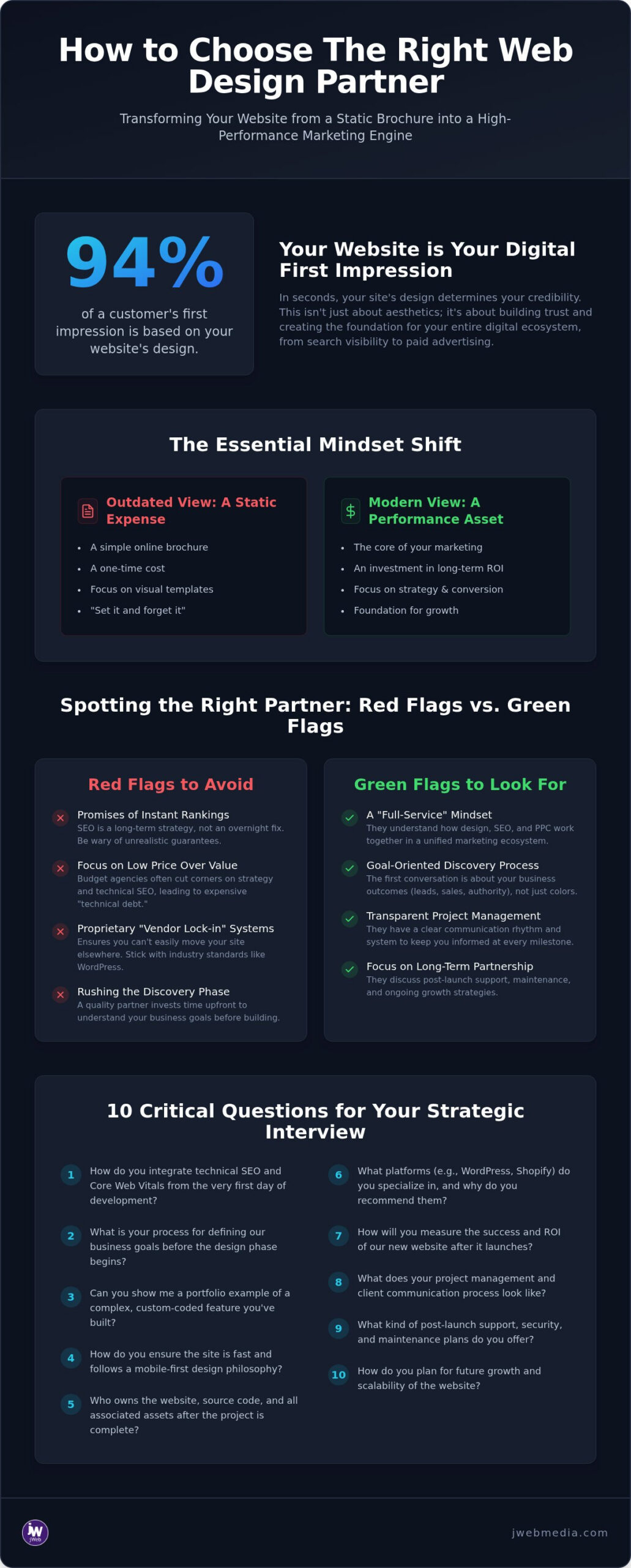
Did you know that 94% of a customer’s first impression of your business is based entirely on your website’s design? In 2026, your digital presence is no longer just a brochure. It’s a high-performance marketing engine that determines your credibility in seconds. Many business owners feel a valid sense of anxiety about this investment. You might worry about overpaying for a generic template or feel confused about where design ends and development begins. It’s common to feel like you’re searching for a partner in a crowded room without a clear map to guide you.
We believe you deserve more than just a pretty layout; you need a site that ranks, converts, and stays secure long after the launch. This guide will show you exactly how to choose a web design company by using a framework that balances high-end aesthetics with technical performance and long-term ROI. We’ll walk through a clear checklist for interviewing agencies and explain why your design must be inseparable from your digital marketing strategy. By the end, you’ll have the confidence to select a dedicated partner who is as invested in your growth as you are.
Key Takeaways
- Shift your perspective from viewing a website as a static expense to seeing it as the high-performance foundation of your entire digital marketing ecosystem.
- Learn how to choose a web design company by applying the “Full-Service” litmus test to ensure your partner understands SEO and PPC as deeply as they do aesthetics.
- Identify critical red flags, such as agencies promising instant rankings, and look for “green flag” discovery processes that prioritize your specific business goals.
- Master the strategic interview with ten specific questions designed to clarify technical ownership and how performance is integrated from the first day of development.
- Discover why a “set it and forget it” mindset leads to lost revenue and how to transition into a long-term growth partnership that maintains your competitive edge.
Why Your Choice of Web Design Company Dictates Your Long-Term ROI
Your website is the heart of your business identity. In 2026, choosing a partner based solely on a low price tag often leads to expensive technical debt. Budget agencies frequently prioritize visual templates while ignoring the underlying site architecture. This oversight creates a “leaky bucket” effect where your marketing dollars vanish because the site can’t convert traffic. When you’re learning how to choose a web design company, you aren’t just buying a layout. You’re selecting the foundation for your entire digital ecosystem, from search visibility to PPC management.
For a comprehensive overview of web design, one must look past the pixels to the strategic intent. A strategic digital partner acts as a supportive guide, helping you define whether your primary goal is high-volume lead generation, brand authority, or streamlined e-commerce sales. This distinction is vital. A site built for brand awareness functions differently than one designed for aggressive sales conversion. A partner who understands this will align their technical execution with your specific business outcomes.
Defining Your Project Scope Before the Search
Before you begin interviewing, you need internal clarity. We often see businesses struggle because they haven’t separated their “must-have” features from “nice-to-have” luxuries. Start by determining a realistic budget that accounts for custom development rather than just a modified theme. A quality discovery process takes time. If an agency promises a complex custom build in two weeks, it’s a sign they might be cutting corners on the strategy phases that protect your ROI. Knowing these details upfront makes it much easier to understand how to choose a web design company that aligns with your specific growth trajectory.
The Link Between Design and Search Visibility
SEO isn’t a coat of paint you apply after the house is built. It’s the structural integrity of the house itself. In 2026, search engines prioritize core web vitals and site speed more than ever. If your design company doesn’t bake technical SEO into the initial wireframes, you’ll spend twice as much later trying to fix performance issues. User experience and search engine optimization are two sides of the same coin; one brings the visitor to your door while the other ensures they find exactly what they need to take action.
Essential Criteria for Evaluating a Custom Website Design Company
Finding a team that can build a website is easy; finding a partner that understands your business is the real challenge. When you’re deciding how to choose a web design company, the first litmus test is their “full-service” literacy. A designer who only focuses on aesthetics without understanding SEO or social media integration is building a digital island. In 2026, your site must work in harmony with every other marketing channel to be effective.
Portfolio analysis should go beyond looking for pretty pictures. You need to see diversity in functionality. Does the agency build complex customer portals, or are they just skinning templates? We recommend sticking with industry standards like WordPress and Shopify. These platforms remain the gold standard because they offer the flexibility to grow without the “vendor lock-in” of proprietary systems. You should also ask about their communication rhythm. A dedicated partner will have a methodical project management system to keep you informed at every milestone.
Technical Proficiency vs. Creative Vision
A stunning site that loads slowly is a failure. Since mobile devices now account for over 60% of web traffic, mobile-first design is a non-negotiable standard. Your agency must demonstrate high-level technical proficiency in custom coding and API integrations. This technical foundation is what allows for Professional PPC management to succeed. If your landing pages aren’t optimized for speed and clarity, your advertising budget will never reach its full potential. Understanding the importance of a strong online presence means prioritizing the user experience as much as the visual appeal.
The Importance of Industry-Specific Experience
Does the agency understand the specific journey your customers take? A B2B long-cycle sale requires a different strategic approach than a B2C e-commerce shop. Review case studies for measurable outcomes like lead volume and traffic growth rather than just design awards. Often, a boutique agency provides a level of personal attention and accountability that large, automated firms simply can’t match. This dedicated approach ensures your project doesn’t get lost in a queue. If you want to see how a partnership-oriented digital agency can transform your visibility, focus on these qualitative indicators during your search.
Red Flags and Green Flags: How to Spot a Reliable Partner
Picking a partner requires looking past the surface level sales pitch. When you’re researching how to choose a web design company, you’ll find that the best agencies act more like consultants than order-takers. A major red flag is any agency promising “instant” Google rankings. SEO is a long game built on technical integrity and strategic content; it isn’t something that happens overnight through a secret shortcut. Conversely, a green flag is an agency that spends the first few meetings asking deep questions about your business model rather than just showing you color palettes.
Another warning sign is the use of proprietary CMS platforms. These systems essentially hold your content hostage. If you ever want to leave that agency, you often have to rebuild your website from scratch because the code won’t work elsewhere. A reliable partner ensures you have clear ownership of all assets and uses universal standards like WordPress or Shopify. They provide transparent pricing and make sure you own the domain, the code, and the data once the project finishes. This level of accountability is what separates a distant service provider from a dedicated partner.
The Danger of Template-Only Agencies
Low-cost agencies often rely on pre-built themes that look acceptable but perform poorly. These templates are frequently filled with “bloat,” which is excessive code that slows down your site and hurts your mobile performance. Custom code always outperforms pre-built themes because it’s streamlined for your specific needs. If you’re stuck between options, read our guide on Custom Design vs. Website Templates to see how templates can limit your ability to scale and differentiate in a competitive market.
Transparency in the Discovery Phase
Professionalism shows in the details of the initial proposal. A vague, one-page document is a red flag that suggests a lack of depth. A detailed roadmap that includes “Voice of Customer” reports shows the agency is designing for your audience, not just for aesthetics. These reports use actual customer feedback to inform the site’s layout and messaging. You should also insist on direct access to the designers and developers working on your project. A supportive guide won’t hide their technical team behind a wall of account managers, ensuring your vision is communicated accurately from start to finish.
The Strategic Interview: 10 Critical Questions to Ask
The interview stage is where you move beyond the portfolio and into the reality of a working relationship. When you’re figuring out how to choose a web design company, the questions you ask should reveal their depth of strategy. Start with the basics: how exactly do they integrate SEO into the initial development? In 2026, if they aren’t planning for schema markup and site hierarchy during the wireframing stage, they’re already behind. You also need to confirm that you will own the domain, the code, and the assets once the final invoice is paid. A reliable partner won’t try to lock you into a proprietary system that prevents you from moving your site in the future.
Ask to see a case study involving a complex technical integration, such as a customer portal or a custom API. This proves they can handle more than just surface-level design. Their testing process is equally important. You should know how they ensure the user experience remains consistent across various devices and browsers, especially since mobile traffic continues to dominate. Finally, clarify their plan for post-launch maintenance. Security updates and technical patches aren’t optional; they’re essential for keeping your business safe and functional long after the initial launch.
Questions About Marketing Integration
Your website doesn’t exist in a vacuum. Ask how the new design will specifically support your PPC and ad spend goals. High-converting landing pages require a specific structure that differs from a standard blog post. You should also find out if they provide a comprehensive SEO Content Strategy or if they simply design the containers and expect you to fill them. A full-service partner understands that the words on the page are just as important as the buttons around them.
Questions About the Working Relationship
Clear expectations prevent project delays. Ask about the turnaround time for feedback and revisions so you aren’t left waiting for weeks. You also need to know how they measure success. Is it just the site going live, or do they track lead conversions and page load speeds post-launch? A true partnership is a shared commitment to long-term growth where both parties are equally invested in the site’s measurable performance. If you’re ready to start this conversation, contact our dedicated team to see how we can guide your next project with transparency and expertise.
Beyond the Launch: Transitioning to a Growth Partnership
Launch day is a major milestone, but it isn’t the finish line. A common mistake many businesses make is treating their website like a static asset. In 2026, the digital marketplace evolves almost weekly. If you want to understand how to choose a web design company that offers real value, you must look for a team that prioritizes long-term performance over a one-time handoff. A “set it and forget it” approach is the fastest way to see your search rankings slip and your conversion rates stagnate as competitors innovate around you.
At jWeb Media, we focus on bridging the gap between building a site and generating actual leads. We use the data gathered from your site’s initial performance to refine your social media and email marketing strategies. This integrated approach ensures your digital presence stays cohesive across every channel. Monthly marketing retainers play a vital role in this process. They provide a steady, expert hand to navigate technical shifts and strategic opportunities as they arise, ensuring your site remains a high-performance engine for years.
The Value of Ongoing Optimization
Optimization is a continuous cycle of testing and refining. Through A/B testing and Conversion Rate Optimization (CRO), we help you understand exactly what makes your visitors take action. This process turns a passive website into an active sales tool. Security is another non-negotiable factor. Regular software updates and security audits for your WordPress or Shopify site are essential to prevent vulnerabilities and downtime. You can learn more about the long-term benefits of this approach in our guide on the Value of Monthly Marketing Retainers.
Scaling Your Digital Presence
Your digital strategy should grow alongside your revenue. This might involve scaling into targeted PPC management to drive immediate traffic or implementing AI Phone Assistants to improve your customer response times. Keeping your content fresh is also essential for maintaining the search authority you’ve worked hard to build. When you’re researching how to choose a web design company, prioritize a partner capable of supporting this full spectrum of growth. If you’re ready to align your technology with your business goals, Connect with jWeb Media for a Custom Strategy Session to start building your long-term roadmap.
Securing Your Digital Future in 2026
Your website is the most valuable employee on your payroll. It works around the clock to represent your brand, capture leads, and drive revenue. Mastering how to choose a web design company requires looking past visual aesthetics to find a partner who understands the technical demands of the current market. You now have a clear framework to evaluate agencies based on their marketing integration, technical proficiency, and long-term commitment to your ROI.
At jWeb Media, we’ve spent over two decades acting as a supportive guide for businesses ready to scale. Founded in 2004, we provide a full-service strategy that bridges the gap between custom design and high-performance SEO and PPC. Our transparent, partnership-oriented approach ensures your site remains a competitive asset long after the initial launch. We believe in building relationships, not just repositories for code.
Ready to build a site that actually moves the needle? Contact jWeb Media today.
The right digital foundation transforms your business trajectory. We’re ready to help you navigate this landscape with confidence and expertise.
Frequently Asked Questions
How much does a custom website from a professional company cost in 2026?
The investment for a custom website depends on the complexity of your project and the specific features your business requires. Factors such as custom API integrations, the number of unique page layouts, and the depth of the initial strategy phase all influence the final price. While some providers offer flat-rate packages, a strategic partner will provide a tailored quote based on your specific goals. This ensures you’re paying for a performance-driven tool rather than a generic template.
How long does the web design process typically take?
A professional custom web design project typically takes between 8 and 16 weeks to complete. This timeline allows for a methodical progression through discovery, wireframing, custom coding, and rigorous quality assurance testing. Rushing through these phases can lead to technical errors or a poor user experience. A steady, intentional pace ensures your site is secure and fully optimized to convert visitors into customers from the moment it launches.
Should I choose a local web design company or a national agency?
You should prioritize the agency’s expertise and their ability to act as a supportive guide over their physical proximity to your office. National agencies often bring a broader perspective on industry trends and have access to a more diverse pool of specialized talent. Modern collaboration tools ensure you stay closely connected with your team throughout the project. The right choice is a partner who understands your landscape and is committed to your long-term visibility.
Will I be able to update my own website after it is launched?
Yes, you’ll have the ability to manage your own content using a Content Management System like WordPress or Shopify. We provide the necessary training so your team can comfortably update text, images, and blog posts without needing technical help. For more complex structural changes or ongoing technical maintenance, many businesses choose to stay on a monthly retainer. This allows you to focus on your business while we handle the technical heavy lifting.
What is the difference between a web design agency and a freelancer?
An agency provides a multi-disciplinary team that includes designers, developers, and SEO specialists working in a collaborative environment. This full-spectrum approach ensures every detail of your site is built with your broader marketing goals in mind. Freelancers are often highly skilled in one area but may lack the bandwidth to handle complex technical problems or provide long-term support. An agency offers the stability and accountability needed for a mission-critical business asset.
Do web design companies also provide SEO and marketing services?
Full-service agencies integrate SEO and digital marketing into the design process from day one. When you’re learning how to choose a web design company, it’s vital to find a partner that understands how site architecture affects your search rankings. Designing with SEO and PPC in mind ensures your site is a high-performance marketing engine rather than just a digital brochure. This integrated strategy prevents expensive reworks and helps you see a return on your investment much faster.
What happens if I need technical support after the site goes live?
Reliable agencies provide ongoing maintenance retainers to handle software updates, security patches, and minor technical adjustments. These plans ensure your site remains secure and functional as web standards change over time. While we don’t offer 24/7 emergency support, our team is dedicated to providing responsive care during business hours. Having a steady hand to manage these updates prevents downtime and keeps your digital presence healthy and professional.
Is it better to use WordPress or Shopify for my business website?
The right platform depends on your primary business objectives. Shopify is the industry leader for businesses focused on eCommerce and streamlined sales processes. WordPress offers incredible flexibility for content-driven sites, custom portals, or businesses that need highly specific functionality. A dedicated partner will analyze your needs during the discovery phase to help you select the platform that offers the best balance of performance and scalability for your 2026 growth strategy.