


The best digital marketing for healthcare providers isn’t the strategy that reaches the most people. It’s the one that helps the right people find clear, credible information while respecting their privacy. Every online interaction, from a search result to an appointment inquiry, can shape a patient’s confidence in your practice.
It’s reasonable to wonder which channels deserve attention first, how to measure results without exposing sensitive information, and whether online engagement is leading to inquiries or appointments. Start by looking at the path a visitor takes: Can they find the right service page, understand what the practice offers, and locate a clear next step? A coordinated approach can make your information more consistent and your digital experience more trustworthy.
This guide outlines practical ways to prioritize your website, search visibility, content, social media, and paid advertising around provider and patient needs. You’ll also learn how to approach measurement with privacy in mind and use clear performance signals to guide next steps. The goal is steady progress built on trust, not more activity for its own sake.
Key Takeaways
- Shape digital marketing for healthcare providers around patient needs, with useful information and clear next steps at the center.
- Use your website, search visibility, educational content, and social media to help people find and understand your services.
- Separate high-level campaign measurement from the collection or transmission of patient-identifiable information.
- Build a manageable plan by setting goals, choosing priority channels, and reviewing progress before adding more activity.
- Connect your website, campaigns, and audience communications so each part of your digital strategy supports the same goals.
What Digital Marketing for Healthcare Providers Needs to Accomplish
Digital marketing for healthcare providers is the coordinated use of online channels to help people find, understand, and take appropriate next steps with a healthcare practice. Its purpose is patient-centered: make reliable information easier to discover and services easier to evaluate, rather than simply promote a provider.
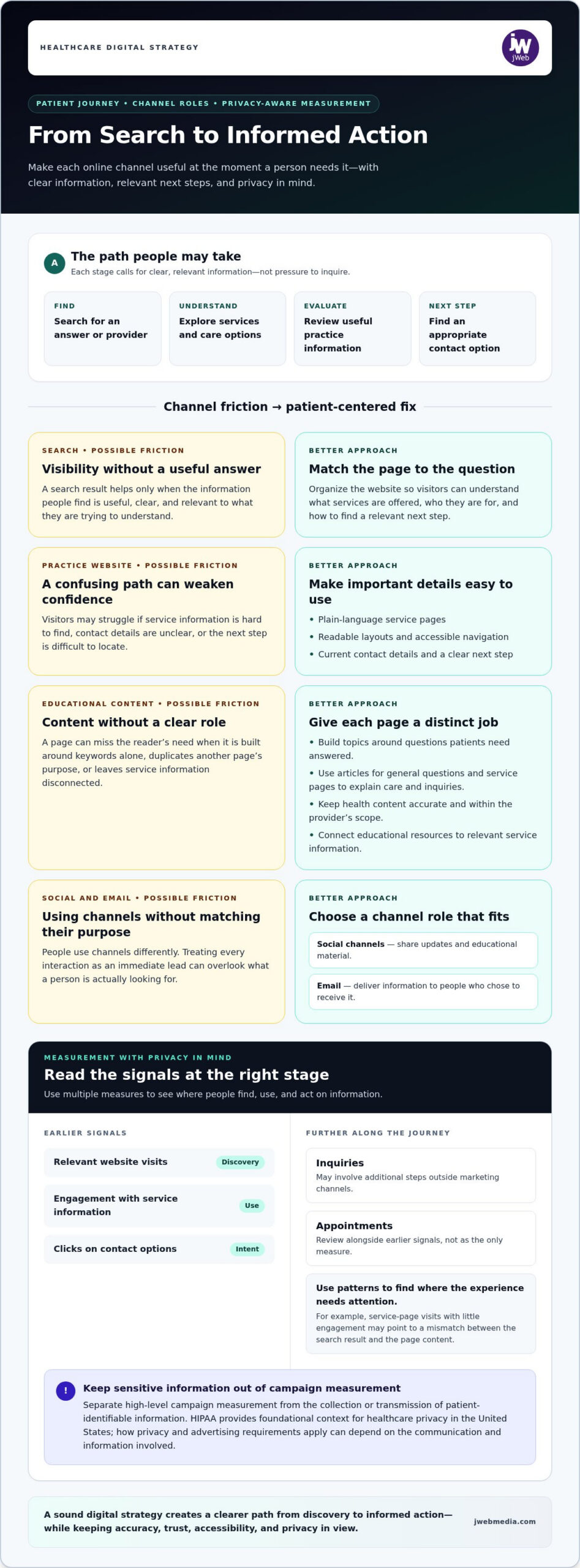
A patient’s path may start with a general question about a symptom or type of care. From there, they might compare services, review a provider’s website, and decide whether to make an inquiry. Each step calls for clear, relevant information. Trust, accuracy, accessibility, and privacy should shape the strategy from the start. A confusing page or careless data practice can undermine confidence before a conversation begins.
How Patients Use Digital Channels When Exploring Care
Different channels support different needs. Search can surface answers to broad questions or help someone find a provider. A practice website can explain services, care options, and how to get in touch. Social channels can share updates and educational material, while email can deliver information to people who have chosen to receive it—often relying on specialized design agencies like The Better Creative to ensure newsletters and announcements are clear, accessible, and well-structured.
General health research doesn’t always mean someone is ready to contact a specific provider. A person may be gathering background information, comparing care options, or looking for practical details before deciding what to do. Their questions and channel preferences can vary by service, audience, and stage of decision-making. Helpful marketing meets those needs without treating every visitor as an immediate lead. For example, an educational page should answer the question it targets and make related service information easy to find, without pressuring readers to inquire.
Privacy belongs in channel planning, too. HIPAA (Health Insurance Portability and Accountability Act) provides foundational context for healthcare privacy in the United States. The way privacy and advertising requirements apply can depend on the communication and information involved, so marketing plans should account for sensitive data rather than assume every online interaction can be measured the same way.
What a Provider Should Expect From a Digital Strategy
A useful strategy sets realistic goals that connect to the patient journey. These might include improving visibility for relevant searches, helping visitors understand services, and making it easier to submit an inquiry. Make the goal specific enough to guide decisions, such as improving the clarity of one service page or helping visitors find the appropriate contact option. The right priorities depend on the practice’s needs and the people it serves.
Measurement should distinguish early signals from later outcomes. Relevant website visits, engagement with service information, and clicks on contact options can show whether people are finding and using information. Inquiries and appointments sit further along the journey and may involve additional steps outside marketing channels. Reviewing these measures together can help a team spot where interest is building and where the experience may need attention. For instance, visits to a service page without much engagement may point to a mismatch between the search result and the page content.
No single tactic guarantees patient growth or a particular clinical outcome. A sound strategy instead creates a clearer path from discovery to informed action, while keeping communication accurate and privacy considerations in view. That gives providers a practical basis for deciding what to improve next.
How Healthcare SEO, Content, and Social Media Build Patient Trust
Search visibility only helps when the information people find is useful and clear. A well-organized website makes it easier for visitors and search engines to understand what services a practice provides, who those services are for, and how to take the next step. Plain-language service pages, readable layouts, accessible navigation, and current contact details all support a more dependable experience. Check that each important service page has a descriptive title, answers the questions visitors are likely to have, and links to a relevant next step.
Each page should serve a distinct purpose. A service page can explain what care involves and how to request information, while an educational article can address a common question. Keep health content accurate and within the provider’s scope. It can explain general concepts and suggest when someone may want to seek professional guidance, but it shouldn’t diagnose a reader or replace individualized clinical advice. Where appropriate, clear authorship and review information help visitors understand who stands behind the content.
Healthcare SEO and Content That Answer Real Questions
Build a content plan around the questions patients actually need answered, not just a list of keywords. Group related topics, give each page a clear role, and connect educational resources to relevant service information. For example, a general article can link to a relevant service page, while the service page explains the offering and how to make an inquiry. Before publishing, establish a process for reviewing accuracy and updating content when information changes. A thoughtful SEO content strategy can align these pages with search intent and the practical decisions visitors are trying to make.
Trust also depends on accessibility. Use descriptive headings, straightforward language, and links that explain what visitors will find. Make important information easy to locate on a phone as well as a larger screen. These choices help people evaluate a service without having to interpret vague claims or search through unrelated pages. In addition to written text, many healthcare groups rely on video specialists like VISIOLAB to transform complex procedures and institutional messages into clear, high-impact visual content that patients can readily understand.
Social and Paid Campaigns With Clear Guardrails
Social media can extend useful information beyond the website. Share service updates, general educational resources, or answers to common questions in a respectful, consistent voice. Avoid inviting people to post personal health details in comments or messages. If someone shares identifiable information publicly, don’t confirm a patient relationship or add private details in response. Instead, direct them toward an appropriate private channel without discussing their circumstances in public.
Paid search can help a practice place relevant service information in front of people actively looking for it. Keep campaign messaging consistent with the landing page, define the intended audience and goal, and assess how interactions are measured before launch. For a practical view of campaign setup and management, see professional PPC management.
Privacy-aware measurement matters across every channel. Aggregate counts, such as overall page visits or campaign clicks, can help teams understand broad performance. But data tied to an identifiable person, or details that reveal a health concern through a visit or interaction, need careful handling. Don’t assume an analytics or advertising tool is appropriate simply because it is widely used. Consider what information a page or tracking tool collects, where it goes, and who can access it. The HIPAA Privacy Rule from HHS.gov offers official background; this overview isn’t legal advice, and requirements can depend on context.
The right mix of SEO, content, social, and paid campaigns depends on audience needs, organizational goals, and the team’s capacity to maintain each channel. Start with the channels that improve access to trustworthy information, then expand as the organization can support them responsibly. That’s how digital marketing for healthcare providers can connect visibility with a more useful, patient-centered experience.
How to Balance Patient Privacy, Compliance, and Marketing Measurement
Healthcare marketing teams need useful performance information, but measurement should not create unnecessary exposure of sensitive data. Privacy and advertising requirements depend on the organization, the information involved, the tools used, and how data flows between them. This section offers practical considerations, not legal advice. Before publishing or changing a campaign, verify current guidance from HHS Office for Civil Rights (OCR) and the Federal Trade Commission (FTC), and involve qualified privacy and legal advisers.
What HIPAA Means for Digital Marketing Decisions
HIPAA doesn’t apply in the same way to every organization or every digital interaction. Whether it applies depends on factors such as the organization’s role, the information collected, the tool processing it, and the specific use. A generic visit count is different from information that identifies a person and connects them to a health concern. But a metric that appears broad can still warrant review if the underlying data reveals sensitive details.
Don’t assume a familiar analytics or advertising platform, a consent banner, or a vendor agreement automatically makes a setup appropriate. Have qualified advisers examine the full data flow, including what a page sends to third parties, how consent is collected, and whether agreements or safeguards are needed. Review landing pages, forms, call tracking, and URL parameters as part of the same assessment.
Measuring Campaigns Without Overclaiming Attribution
Start with the question the team needs to answer, then choose the least identifying measure that can help. The examples below are starting points for discussion, not a determination that any tool or measurement method is compliant.
| Useful marketing question | Lower-risk aggregate measure | Review needed |
|---|---|---|
| Are people finding the campaign page? | Overall page visits by campaign source | Check identifiers, URLs, and what data analytics tools receive. |
| Are visitors beginning the inquiry process? | Aggregate form-start or completion counts | Review form fields, tracking events, consent, and any information passed to vendors. |
| Are campaign calls increasing? | Overall call volume by campaign | Assess call-tracking setup, recordings, and whether caller details are collected. |
Use these indicators to spot patterns, not to claim more than the data supports. A reported conversion can show that an action followed a campaign interaction; it doesn’t prove that the campaign caused an appointment, a treatment decision, or a clinical outcome. Keep marketing reports focused on their intended purpose.
Set access controls and data-retention practices with the organization’s privacy team. Limit access to people who need the information, agree on how long records are kept, and revisit the setup when campaigns or tools change. A careful approach helps digital marketing for healthcare providers produce clearer insights while respecting the boundaries around patient information.
How to Build a Practical Healthcare Digital Marketing Plan
A useful plan connects one provider goal to the people it serves, the information they need, and the team’s ability to deliver it. Rather than launch everywhere at once, create a clear starting point, establish a baseline, and improve in manageable steps. This makes digital marketing for healthcare providers easier to coordinate and gives the team a clearer way to assess progress.
Set Goals, Audiences, and a Useful Baseline
Before choosing tactics, define the service line, the audience need, and the next step you want your digital experience to support. Then review what’s already in place: website pages, search visibility, active campaigns, and the path from an online visit to an inquiry. Record a baseline before making changes, so you can compare later performance with a meaningful starting point. Note which pages get relevant visits, whether key service information is easy to find, and how visitors can make an inquiry.
Choose Channels and Improve Them in Sequence
Use the findings to select a small number of priorities. A channel is only useful if it serves the audience and the team can maintain it. Work through this sequence, adapting it to your organization’s goals and capacity:
- Choose a focused goal. Identify a specific service or information need to support. For example, a team might aim to make a particular service easier to understand and its inquiry pathway easier to find.
- Define the audience and next step. Describe who needs the information and what action makes sense for them, such as reviewing service details or starting an inquiry. Keep the message focused on that need.
- Review the existing experience. Check that relevant website pages are clear, current, and easy to navigate. Look for gaps between what a campaign or search result promises and what the visitor sees after clicking.
- Set the baseline and measurement boundaries. Select a small set of indicators tied to the goal, such as relevant page visits or aggregate inquiry counts. Review the measurement approach with the organization’s privacy team before collecting or sharing data.
- Make one or two improvements, then assess them. Improve a priority service page or related search content before adding channels. Consider paid campaigns once the audience, landing experience, and measurement plan are ready, and make sure the team can manage the activity consistently.
Keep the review cycle simple. Each month, compare current indicators with the baseline, note what changed, and record what the team learned. Check whether people can find the information, whether the next step is clear, and whether the work remains manageable. Use those observations to set the next priorities. Avoid treating reach or clicks as success on their own if they don’t support the original goal.
A written plan also helps keep teams aligned. Capture the goal, audience, selected channels, responsible owners, measures, and next review date in one shared document. That record makes decisions easier to revisit when priorities or available capacity change.
For a connected approach to website, search, content, and campaigns, review jWeb Media’s digital marketing services.
How jWeb Media Can Support a Connected Healthcare Marketing Strategy
A healthcare marketing strategy works best when its parts support the same provider goals. jWeb Media offers custom website design, SEO, PPC management, social media management, and content marketing. The agency combines strategy and technology to connect organizations with their audiences. For providers, that means planning the website, search presence, campaigns, and communications as connected parts of the patient experience.
The right mix depends on the services you want to explain, the audiences you need to reach, and the internal capacity available to maintain marketing activity. The aim is a practical, coordinated plan, not a promise of specific patient, ranking, or revenue outcomes.
Connect the Website, Search, and Campaign Experience
Your website is often where people go to understand a service after finding it through search, social media, or an ad. Custom website design can help organize service information and make useful next steps easier to find. Clear page structure also gives SEO and content marketing a strong foundation: search visibility brings relevant visitors, while useful content helps them understand what the provider offers.
Paid campaigns can complement that foundation by promoting specific services or information to a defined audience. Their landing pages should carry through the campaign’s message and give visitors a relevant next step. Social media can support awareness and share helpful updates, while content can answer recurring questions. Coordinating these channels helps prevent mixed messages and makes the experience more consistent from first click to inquiry.
jWeb Media can bring these elements together around your objectives, audience needs, and available team capacity. A provider with limited time for regular publishing may prioritize core website pages and search content before expanding social or campaign activity. A team preparing to promote a specific service may first focus on whether its service page and inquiry pathway are ready. The priorities should fit the organization, not a one-size-fits-all channel checklist.
Turn Strategy Into an Ongoing Partnership
A connected plan needs room to adapt. Reviewing campaign and website performance can help teams identify which information people engage with, where the experience may need improvement, and what to prioritize next. Those insights can inform adjustments to content and campaign focus, while measurement and data practices should remain aligned with the organization’s privacy review. Decisions should be guided by evidence and provider goals, without overstating what marketing data can prove.
jWeb Media serves customers nationally across the United States. Whether your organization is aligning a website with search content or coordinating paid campaigns with broader communications, a collaborative process can keep the work focused and manageable.
Discuss a connected digital marketing strategy with jWeb Media and explore a practical plan for your organization.
Make Your Next Digital Improvement Count
The next step doesn’t need to be a sweeping campaign. Choose one point where people may struggle to find, understand, or act on information, then agree on what a useful improvement would look like. That focus gives your team a manageable place to begin and a clearer basis for deciding what to work on next.
Strong digital marketing for healthcare providers grows through deliberate choices. Keep patient needs at the center, align the work with your team’s capacity, and make privacy part of planning rather than an afterthought. With a clear priority and a shared direction, each improvement can contribute to a more consistent online experience.
jWeb Media takes a collaborative approach to planning digital strategies around organizational goals. Ready to explore a connected approach for your practice? Contact jWeb Media to discuss a digital marketing strategy built around your goals.
Frequently Asked Questions
Is digital marketing worth it for a small healthcare practice?
Yes, digital marketing for healthcare providers can be worthwhile for a small practice when the work supports a clear business need. For example, a practice could first improve how one service is described online, then check whether visitors can find the relevant contact information. Keep the effort proportionate to staff capacity and review progress against a few useful measures. The value depends on the care offered, audience, competition, and quality of execution, not a guaranteed appointment count.
Can healthcare providers use patient testimonials in digital marketing?
They may be able to, but testimonials call for careful review before publication. A patient’s public review doesn’t automatically give a provider permission to reuse it in promotional content or confirm the person’s relationship with the practice. Consider how the testimonial was gathered, what claims it makes, and where it will appear. Obtain appropriate permissions and have qualified privacy, legal, and professional reviewers assess the wording and disclosures before sharing it.
How long does healthcare SEO take to show results?
There’s no reliable fixed timeline for healthcare SEO results. The starting condition of the website, competition for relevant searches, content quality, and the work completed all affect progress. Technical improvements may make a page easier to use before search visibility changes. Track a few relevant measures over time, such as impressions for priority searches and visits to the related service page. Treat early movement as a signal to evaluate, not a forecast of future inquiries.
What digital marketing metrics should healthcare providers track?
Track measures that answer a specific question about your marketing. If the goal is visibility, review relevant search impressions and visits to key pages. To assess engagement, look at meaningful actions such as calls or visits to contact information. For campaigns, compare approved response measures with campaign sources. Define what counts as a qualified inquiry before reporting results, and keep clicks, inquiries, appointments, and clinical outcomes distinct. A marketing interaction alone can’t establish that it caused a health outcome.
Can healthcare providers use Google Analytics on their websites?
Possibly, but whether a particular Google Analytics setup is appropriate depends on the organization, configuration, information collected, and how data is used or shared. A standard installation shouldn’t be assumed suitable for every healthcare site. Ask qualified privacy and legal advisers to review the pages involved, tracking settings, consent flow, vendor terms, and data sent to third parties. Keep the measurement focused on necessary marketing questions and avoid collecting sensitive information without a clear, reviewed reason.
Should healthcare providers manage digital marketing in-house or with an agency?
Choose the arrangement that fits your staff’s capacity, technical needs, and review process. An in-house team may be well placed to share operational context and coordinate approvals. An agency can help organize strategy and execution across multiple channels. A hybrid model can also work, with an agency handling defined marketing tasks while practice staff review clinical accuracy and organizational messaging. Before work begins, assign owners for content approval, privacy review, campaign decisions, and reporting.